
All along Iran has been playing a different historical game than we have
And the question never should have been whether we go to war with the regime, but when...

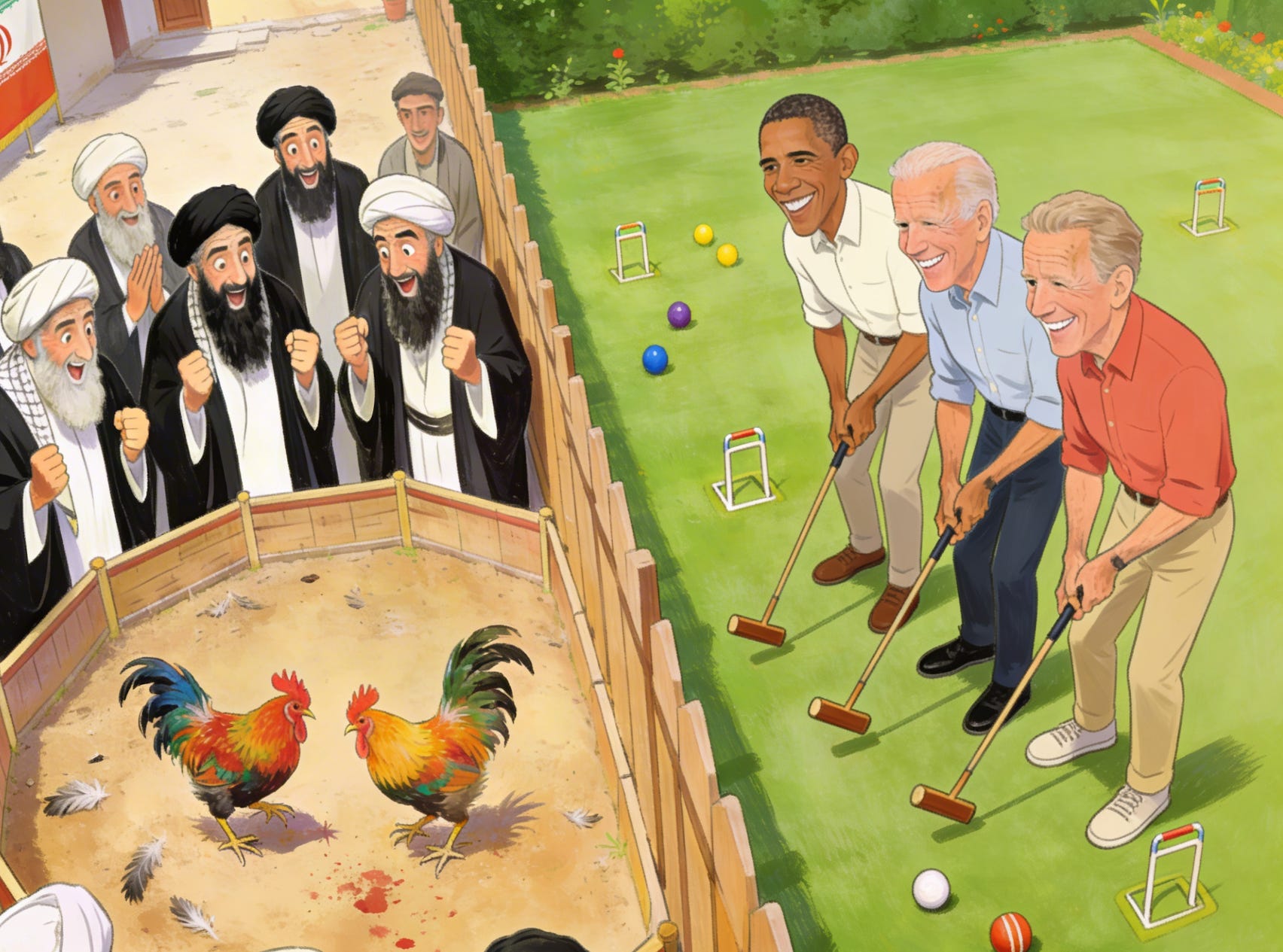
On Saturday, February 28, 2026, the inexorable turned existential.
Trump stopped rattling and finally rolled the dice, and – as the hackneyed adage runs – the rest is history.
Or at least a history that is still wild and wide open, while it is still unraveling!
Since the bombs started raining down this past weekend, I’ve been thunderstruck myself by how the narrative on the part the anti-Trumpiest amid the crush of Anti-Trumpists has shifted noticeably in less than 72 hours.
As late as Epic Fury Eve the indeterminable burble among the condescending commentariat was loudly and consistently chicken-littleish.
Now that it is not the sky but the villainous Iranian regime that seems to be crumbling, the OMG crew seems to be squalling about every imaginable doomscape their feverish basal ganglia can engender.
No matter with how much of a white heat is radiated from your hatred of Trump, you can’t really say even among the most ethically challenged within polite society that he somehow out-evils the Ayatollah.
So you need to keep your murmuring confined to what a mess his itchy trigger finger has made of our barricaded blue-statish redoubts.
Consider Heather Stewart writing in The Guardian on Sunday.
Donald Trump’s attack on Iran, with its puerile Pentagon nametag Operation Epic Fury, is another show of violent force from a bullish administration. Aside from unleashing fresh instability across the Middle East, the strikes add to the sense of a US operating with little regard for international law or global norms – as with Trump’s on-off tariff regime, and the attack on Venezuela. In the financial sphere, that is only likely to add weight to an incremental but historic shift away from the global dominance of the US currency and towards a more complex world that may be less to Washington’s liking.
Hmm. That’s interesting. According to CNN, the dollar rose the next day as a “safe haven” currency.
We’re also told we need to worry about the price of gas, inflation, the national debt, fewer missiles to aim at China whenever they launch Taiwan, etc.
However, the cavil that seems to come up the most is not that Trump started the war but that he has no “plan” to finish it, as if any triumphal hegemon in human history had some exhaustive, pre-approved design sketch to cap off the combat in which it found itself embroiled in the first place.
The persistent mantra among the President’s detractors that he launched a “war of choice”, as though any chief executive can call for military strikes with the same consumerist aplomb as some high school girl picks out her prom dress, is pure sophistry in its most elevated guise.
Most difficult choices are forced choices. That is, they come down to having to select between bad, worse, and worst.
So we need to ask ourselves this particular question: what if President Trump had not chosen to go to war on Saturday morning?
The ancillary question would be what it would be like to deal with an Iran six months from now that had restored from the war in June 2025 most, if not all, of its missile capabilities and had rebuilt, or come near to rebuilding, the infrastructure to manufacture nuclear weapons?
More importantly, what would have been the mentality of a leadership, which for 47 years had castigated the United States as “the Great Satan” and finally had the wherewithal to engage it militarily?
For the last decade the same critics have harped on whether American military action is wise. But they have strangely balked at inquiring what the Iranian clerics believe about their own unique and providential role since the 1979 revolution itself in bringing down what they have long branded as the most evil empire on earth.
Ironically, Iran’s Supreme Leader even excoriated the United States as worse than the Devil himself, whom Muslims call “Iblis”.
In a 2015 address to the Islamist faithful, Ali Khamenei declared:
…according to the Holy Quran, the only thing that Iblis can do is to tempt human beings and nothing more. He tempts and deceives people, but America kills, imposes sanctions and behaves in a hypocritical way as well as tempting and deceiving.
The Islamic Republic of Iran is not in any palpable sense a nation that views itself as a conventional, sovereign international actor with rational interests. All along it has been a revolutionary theocracy preoccupied with its own divine and implacable mission, regardless of the costs.
In fact, one Iranian analyst, echoing former Secretary of State Henry Kissinger, has described it as “cause” rather than a country.
Moreover, Iran has never expected to defeat the United States straightforwardly on the battlefield. It has looked instead to outlast us, and it has harbored its own detailed and surprisingly strategic “plan” to accomplish its fanatical aims.
Writing in the National Review, Danielle Pletka traces the source of America’s botched assessment of the Islamic Republic’s intentions to the onset of the Iranian revolution in a 1978 cable in which American Ambassador William Sullivan naively described the Ayatollah Ruhollah Khomeini as “Gandhi-like.”
At the time UN Ambassador Andrew Young stoked the Carter administration’s own well-documented delusions with his chipper prediction that Khomeini would “be somewhat of a saint when we get over the panic.”
Forty-seven years later following 241 dead Marines in Beirut, 19 in the Khobar Towers bombing in Saudi Arabia, and 17 documented IRGC plots on American soil, official Washington’s congenital fantasies about the mindset of the government in Tehran persist, especially now on the Democratic side of the aisle.
Both conservative and liberal pundits and policy analysts have doggedly treated the Iranians as adversaries with whom they can dicker and do business, all the while seeking to prod through incentives into acceptable behavior.
Every American administration since Carter has operated from this set of premises.
Every single one has allowed itself to be systematically hoodwinked.
It is the profound and unappeasable prejudices of the secular, post-Westphalian Western security establishment and its phalanxes of international relations “experts” that makes us perpetual dupes of the ayatollahs’ machinations.
The concept at the core of the foreign and domestic policy of the Islamic Republic is velayat-e faqih — the rule, or “guardianship”, of the Islamic jurist.
Iran is unique within the Islamic world because since at least the sixteenth century it has anchored and crafted its national identity through a minority – and what many Muslims regard as “heretical” – sect of Islam known as Shi-i, or “Shiism”.
The classical Shia position held that in the absence of the Hidden Imam - the Twelfth Imam who disappeared in 874 CE and whose return marks the End of Days - political authority was inherently illegitimate.
Yet in his 1970 treatise Islamic Government Ayatollah Khomeini insisted that a qualified jurist must actively govern in the Imam’s absence, exercising near-absolute political and religious authority, not merely over Iran, but ultimately over the entire Muslim world.
As Khomeini wrote, the scholars “should join hands” to “establish a just government in the world.”
Reader take note.
Not in Iran. In the world.
Khomeini’s transnational ambition is not incidental to the worldview. In Paris on February 26, 1979, just days before his triumphal return to Tehran, Khomeini told a Kuwaiti delegation:
I hope that all Islamic nations who have been disintegrated and take opposite sides to each other due to the propaganda of foreigners, wake up and be with each other and build one great Islamic state, one state under the flag of ‘No god but Allah,’ and this state dominate the whole world.
Khomeini was not indulging in revolutionary bluster. His vision is encoded in the founding documents of the Islamic Republic itself.
The preamble to the Constitution of the Islamic Republic proclaims that the Revolution was “a movement aimed at the triumph of all the mustad’afun [the oppressed] over the mustakbirun [the arrogant]”. Quoting the Qur’an 21:92, it adds that the Constitution “provides the necessary basis for ensuring the continuation of the Revolution at home and abroad,” striving “to prepare the way for the formation of a single world community”.
The section concerning Iran’s armed forces is even more explicit. It charges the IRGC not only with guarding Iran’s borders but with “fulfilling the ideological mission of jihad in God’s way; that is, extending the sovereignty of God’s law throughout the world.”
Article 154 closes the architecture for the ideology of the Islamic Republic, which “supports the rightful struggle of the oppressed people against their oppressors anywhere in the world.”
It is no accident that the secular West in America has often joined in a strange nexus with Islamist radicals and why Khomeini’s lifelong campaign to annihilate Israel has become its own cause célèbre in recent years among the former.
When Tehran refers to America as the “Great Satan” - Shaytan al-Akbar - it is expressing a specific theological type of anathematization, not a political grievance.
Only this distinctive style of odium theologicum on the part of Iran’s leadership can shed light on what has bewitched every American administration for at minimum two generations.
Why, confronted with overwhelming military power, crushing sanctions, 30,000 of its own citizens butchered in the streets, and 60 percent inflation ravaging its economy, does the regime still refuse to make any kind of deal that would have prevented what finally came down on February 28?
The answer is simple. Even the most tepid gesture of capitulation in the minds of Iran’s mullahs would be equivalent to apostasy.
In January 1988 Khomeini asserted that advancement of the Islamic state outranked “all secondary ordinances” of Islam, including “prayer, fasting, and pilgrimage.”
The struggle against the Great Satan, according to Khomeini, was to be considered more obligatory than the Hajj, or pilgrimage. Making a genuine, binding deal with the Great Satan does not count simply as a political miscalculation. It is an unpardonable sin.
How does the regime believe it will ultimately prevail? Merely by surviving long enough for history to turn.
The nuclear program has always served as the ganglion of this game plan. A nuclear deterrent permanently insulates the regime from decapitation, allows the proxy network to operate with impunity, and validates the theological meme that God has protected the Islamic Republic through every trial and tribulation.
Khomeini himself framed the ultimate outcome in terms that clarify what success looks like:
Either we shake one another’s hands in joy at the victory of Islam in the world, or all of us will turn to eternal life and martyrdom. In both cases, victory and success are ours.
The June 2025 air assaults by Israel and the United States badly damaged Iran’s “Axis of Resistance” and set back the nuclear program. But Iran’s standardized response documented through February 2026 has been entirely consistent with its long-game doctrine - burrow deeper, rebuild covertly, engage diplomatically as a tactical cover, and wait for American attention to shift elsewhere.
But has remained paramount all along in Iran’s diplomatic dance with its sworn enemy is a little known and far less understood pillar of Shia Islam known as taqiyyah - the principle of religiously sanctioned deception when the community faces existential threat.
The great Shia jurists treated it not as regrettable compromise but as a positive religious duty when survival required it. In the context of Iran’s nuclear diplomacy, every negotiation has been a potential exercise in taqiyyah — not a good-faith effort to resolve differences, but a feint to buy time.
The Algiers Accords of 1981 between the U.S. and Iran freed the hostages and unfroze $8 billion in Iranian assets. Within two years, Iranian-directed proxies bombed the Marine barracks in Beirut.
In 2003 Iran suspended its formal nuclear weapons program and simultaneously advanced the enrichment infrastructure the program depended on.
The 2015 Joint Comprehensive Plan of Action (JCPOA) provided Iran with $150 billion in sanctions relief. Iran used the breathing room to expand centrifuge knowledge, missile capabilities, and its proxy network.
When Trump withdrew in 2018 Iran resumed enrichment at a pace that compressed its breakout time to approximately one week before last year’s strikes.
Each episode has followed the same pattern. Taqiyyah is not a character defect of individual Iranian negotiators. It is a theologically grounded policy instrument - holy concealment of intentions in service of ultimate victory.
Epic Fury may not, as its proponents hope, resolve the half-century Iranian conundrum in a “decisive” manner any more than Midnight Hammer in June 2025 put to rest the nuclear issue.
But it has never been a matter in the last 47 years of whether we will have to go to war with Iran. It has consistently remained a question of when.
Iranian state Shiism has since the very beginning envisioned an apocalyptic showdown with the Great Satan.
Would we have been better off to let the mass murderers of 30,000 or more Iranian citizens to stipulate the rules of engagement in the relative near term?
The outcome might have instead been 30,000 Americans as well.