

No analyst not anywhere within our solar system could have predicted, according to the Jerusalem Post, that the Iran melodrama would still be heading toward climax as late as February 2026.
Yet here we are, on the knife edge of what could be the most consequential military decision of Donald Trump’s presidency.
The clock is running out on diplomacy. Two aircraft carrier strike groups are now positioned in the Persian Gulf. F-22s and F-35s have been repositioned.
The armada is in place, and if war comes, Americans must realize that the battlefield will not be confined to the Middle East.
The Wall Street Journal reported this past week that the Pentagon has assembled its largest concentration of airpower in the Middle East since the 2003 Iraq invasion, with options stacked on Trump’s desk ranging from a limited strike on nuclear and missile facilities to a broad campaign designed to eliminate scores of Iranian leaders and topple the government tout d’un coup.
CNN claimed the White House has been briefed, and a military could well-nigh be imminent. The Post’s Yonah Jeremy Bob laid out four possible timing windows today and surmised that sooner rather than later as the most probably scenario, given the monumental costs of keeping this armada deployed, not to mention Trump’s congenital impatience with protracted standoffs.
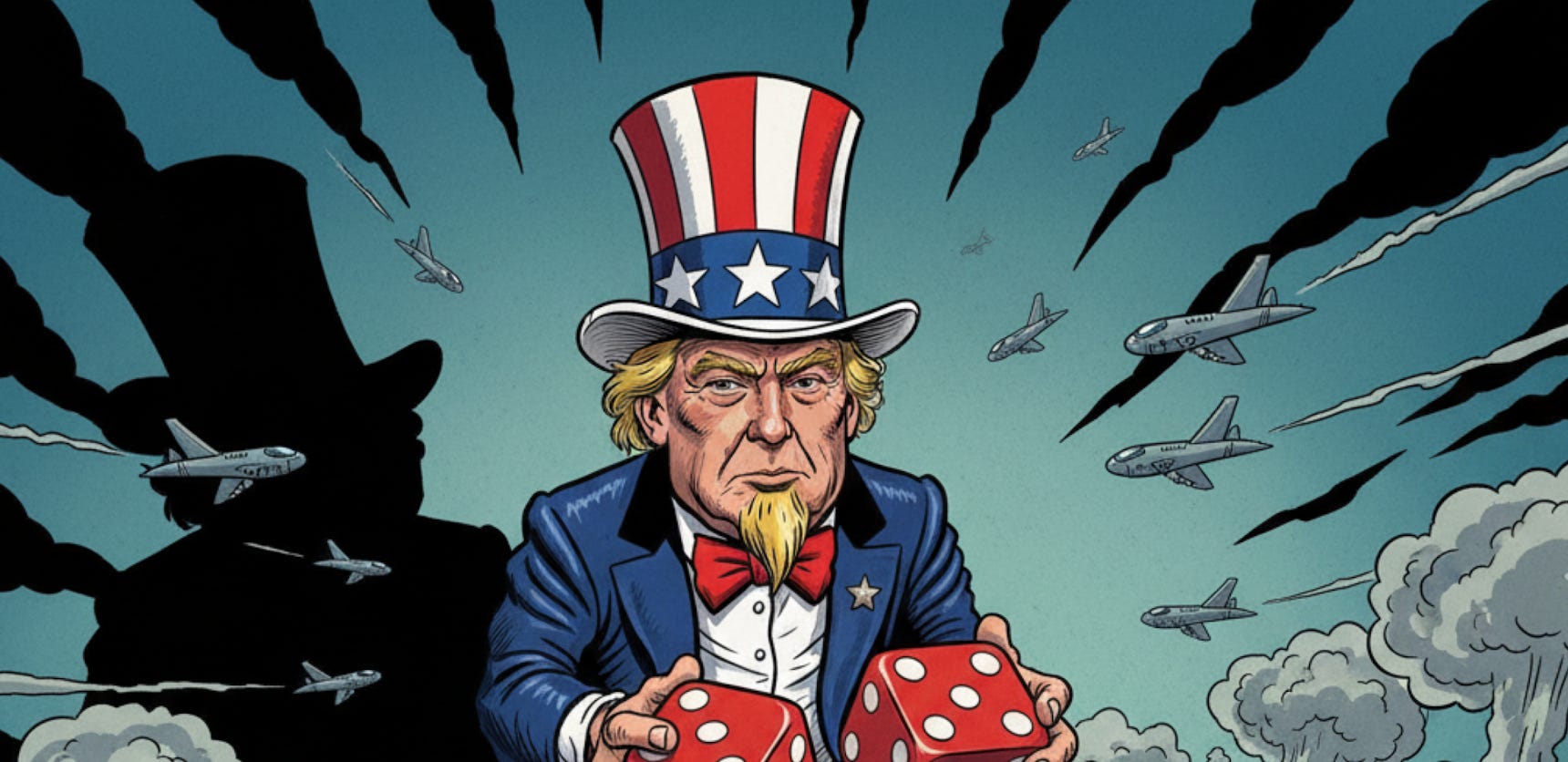
Of course, the dice have not yet been cast, even though they soon will be. And when Trump rolls the dice, what will matter most to the American public is not who wins the air war over Iranian skies.
The question instead will be - what happens to us over here?
As pundits and news commentators have reminded us ad nauseum in passing weeks, the Iranian regime seems cornered, and has turned into a snarling, desperate, and unpredictable wild brute.
The June 2025 Israeli-American strikes destroyed roughly two-thirds of Iran’s ballistic missile launchers and between a third and half of its pre-war missile arsenal. Key IRGC commanders are dead, including the IRGC intelligence chief and his deputy.
Iran’s air defense network was shredded, and Hezbollah’s second-strike capability in Lebanon was neutralized. The Islamic Republic that would confront a second American blitz is considerably weaker than the one from last summer.
Nevertheless, Iran is rebuilding its arms capacity at an extraordinary pace, and it is doing so much more smartly and with real finesse.
Satellite imagery from February 2026 shows fresh concrete hardening tunnel entrances at Natanz. At its Parchin military complex Iran has completed a concrete sarcophagus around a nuclear facility and is now burying it beneath ground.
Iranian engineers are boring 800 meters into granite a new facility known as “Pickaxe Mountain” south of Natanz at a depth they hope will defeat the GBU-57 bunker-buster that B-2 bombers dropped during Operation Midnight Hammer.
Meanwhile, the Alma Research Center estimated this week that Iran’s regime has massacred over 30,000 of its own citizens since the December 2025 protests begin, an historically unprecedented number that President Trump himself cited.
The regime is fast reconstituting its own strike capabilities and slaughtering its own citizens in the same breath, because it – rightfully - anticipates that the next strike may be threaten not just its nuclear program, but at its very survival.
The prospect of regime decapitation is what transforms the impending conflict from a limited military exchange into a likely fuse to ignite full-scale war. According to the Washington Institute, Trump has reportedly asked his generals for “decisive” military options, and that the administration may be contemplating taking out Supreme Leader Khamenei himself, reading from the same script as in Venezuela.
If that option is indeed implemented, Iran’s response will not be calibrated, but totally unconstrained. The Middle East Institute estimated this week that Iranian commanders are openly discussing what can be dubbed a “madman strategy”.
Such a scenario is not in any fashion tantamount to attempting to defeat the United States militarily.
On the contrary, it seeks to regionalize any conflict immediately at its outset. It would, for example, encompass striking U.S. bases across Iraq, Qatar, and the Gulf, jeopardizing Gulf oil infrastructure, closing or mining the Strait of Hormuz, and activating every proxy network still operational across the Middle East.
Khamenei himself has warned: “If you start a war, it will become a regional war.” Iran still has short-range ballistic missiles capable of hitting every U.S. installation in the Persian Gulf, and it used them against al-Udeid Air Base in Qatar as recently as June 2025.
Thirty to forty thousand American troops are currently stationed across eight or nine facilities in that region, as Secretary of State Marco Rubio acknowledged this week. Every one of them is inside Iran’s strike radius.
We also have to take seriously the knock-on impact with respect to global oil markets. Notwithstanding the likely Houthi disruption of the Bab al-Mandab Strait in the Red Sea, Iran’s ability to menace ships traversing the Strait of Hormuz provides Tehran with an economic backsword with truly global reach.
A mining operation or naval interdiction campaign in the Gulf constitutes an effective asymmetric surrogate for any type of kinetic military engagement. Iran can easily make shipping insurance premiums so catastrophically costly that tanker traffic grinds to a halt.
An oil shock of that magnitude would pummel American consumers as well as European and Asian allies simultaneously, rendering political support for a prolonged military campaign extremely difficult to maintain. As one commentator has put it succinctly, “the next war might start not in downtown Tehran, but in the Strait of Hormuz and the Persian Gulf.”
What makes full-scale war more likely than not is the ambiguity of Trump’s own calculations. If a U.S. strike is restricted to nuclear facilities, missile launchers, or air defense nodes, Iran has a strong incentive to respond proportionally, absorb the damage, and return to the negotiating table from a position of demonstrated resolve, as was the case last summer.
But if Trump’s authentic objective, as a New York Times article has indicated, is regime change, then the calculation for the mullahs themselves becomes “existential”, and existential calculations tend to yield existential responses.
If Tehran believes its very existence is at stake, it may very well export such a war to the American homeland, an alternative future the mainstream media is decidedly, albeit perhaps for good reason, underplaying.
If anyone is actually paying attention, however, the possibility of Iranian retaliation in the guise of terrorist attacks on American soil has been formally assessed, authoritatively declared, and forecast through documented operational history that should be deeply unsettling to domestic security analysts, if not the public at large.
The Department of Homeland Security has already issued a National Terrorism Advisory System bulletin advising that conflict with Iran has produced a “heightened threat environment in the United States.” According to the Combatting Terrorism Center at West Point, the FBI surged its monitoring of Iran-backed operatives before the strikes the past summer summer and pulled counterterrorism agents off immigration cases to restore focus on Iran.
The 2025 ODNI Annual Threat Assessment states that Iran “remains committed to its decade-long effort to develop surrogate networks inside the United States” and is actively seeking to target current and former U.S. officials as retaliation for the Soleimani killing. The West Point research facility documented at least 17 disrupted Iranian plots on U.S. soil in the past five years — a pace of approximately one foiled attack every three to four months.
The typical threat vector of foreign or domestic proxies as part of a chain of command launching pre-meditated operations in the aftermath of American military strikes on Iran becomes irrelevant in this particular context. Iran does not need to smuggle IRGC commandos across the southern border to carry out a domestic attack.
The Iranian regime already has what U.S. counterterrorism officials call a “homeland option”, consisting in a layered set of capabilities that includes Hezbollah cells with existing U.S. logistics networks, criminal surrogates recruited through cartel-linked organizations and organized crime cut-outs, and coerced assets within diaspora communities whose family members in Iran are held as effective hostages.
The U.S. Treasury department already fingered one Iranian narcotics trafficker in early 2024 specifically for running a network that recruited Canadian Hell’s Angels bikers to carry out assassinations inside the United States.
According to a Washington Institute podcast, a Hezbollah operative in Texas purchased 300 pounds of ammonium nitrate. Another conducted surveillance operations in New York and Canada.
In the near term, especially when IRGC leadership has been degraded by last summer’s strikes, the most likely domestic attack matrix is not a planned, sophisticated IRGC operation but something harder to detect and intercept - criminal proxies, or lone offenders inspired by Iranian state messaging to act with minimal coordination and maximum deniability.
And in the context of a full-scale war, in which Iranian state media and Quds Force-linked social media operations would immediately pivot to incitement of anyone anywhere to strike American targets, American officials, icons of American prestige and power.
The 17 disrupted plots underscore those bad actors law enforcement apprehended. The sticky question, which no official wants to answer publicly, is how many they didn’t.
None of the foregoing compels us to assert that war is inevitable, or that Iran will necessarily select the option of domestic terrorism over calibrated regional retaliation. Tehran is not suicidal, and grasps that a mass-casualty attack on U.S. soil would inevitably spur a reaction that liquidates the regime once and for all.
The deterrent effect of such an understanding remains substantial.
Yet that style of deterrence only applies to rational actors under normal circumstances. The situation today is far from normal.
The Islamic Republic in February 2026 is a regime has just slaughtered 30,000 of its own people, is having to cope with 60 percent inflation, and may be facing a leadership succession crisis if its Supreme Leader is killed or incapacitated. It is also scrambling to make its nuclear weapons program operational before Israel or the United States can bomb it to oblivion on the next occasion.
Rational-actor paradigms have a poor track record in exactly these sorts of conditions.
The Jerusalem Post is right that every analyst has been wrong so far about what has transpired to date in the ongoing Iran crisis. It is also correct in its wry observation that Iran is extraordinarily skilled at drawing out negotiations — and that Trump is truly and uncharacteristically torn toward multiple compass points.
Trump has hastened decision day with his own bruited red lines and deadlines. The Ramadan window closes March 19.
The dice are warming in Trump’s hands. Whenever they clatter upon the table, the reverberations will not peter out at the Persian Gulf.
They will be felt in Peoria, Portland, and Poughkeepsie as well.