
Why the future of our "knowledge economy" belongs to the arts as well as the humanities
And how a famous philosopher made that discovery 250 years ago

Last week I was honored with an invitation to participate in the Rocky Mountain Economic Summit, an annual gathering of top-tier executives, financiers, political influencers, and thought leaders at the Bronze Buffalo Club and Resort in Victor, Idaho, situated right across the border from Jackson, Wyoming.
The Jackson area — popularly known as “Jackson Hole” — has recently commenced in many respects to upstage Aspen, Colorado as the preferred playground for both domestic and international movers and shakers.
Nestled very near to the southern perimeter of world-renowned Yellowstone National Park and in the shade of the sublime and towering Grand Teton mountain range, Jackson Hole is a spectacular venue also for higher order strategic thinking and bold vision-casting.
Positioned mainly as a tagalong to my colleague Gary Bedford, a Boulder, Colorado-based wealth advisor and vice-president of The Whitestone Foundation on whose board of directors we serve together, my role was that of intellectual advisor and as a networker.
Because of his “Wild Globalization” initiative — an exciting and truly revolutionary public education project that emerged from a class I taught at the University of Denver for several decades and has now been folded into Whitestone’s “thought leader” programming — Gary had been asked to give the closing and summative speech at the economic summit.
On June 16, the last day of the summit, he hit it out of the park and received a standing ovation.
For the rest of the evening in the cool, coral-hued mountain twilight the hot topic of conversation was not just Gary’s talk and the “WG” (as we designate it) prospectus, but the “Knowledge Futures” venture of the Whitestone Foundation itself.
Gary’s wider mission both to frame and stitch together somehow in his own commentary all the motifs of the other conference presenters remarkably reverberated with the opening address by Paul Ryan, former US Speaker of the House from 2015-19.
Ryan started off the morning by naming two shocks now coursing through both geopolitics and the global economy simultaneously — the intensifying war with Iran and the accelerating deployment of artificial intelligence.
For over half an hour he leaned on the disquieting message that volatility, uncertainty, and unpredictability are now and for the foreseeable future not the exception, but the norm.
That resonated like a flexed bowstring with Bedford’s signature catchphrase intrinsic to the WG project — “it’s wild!”
Bedford’s proposition in his speech was that knowledge and wisdom have come uncoupled in our chaotic age, and that the differentiator between the two has been effectively erased.
For Bedford, Ryan’s two contemporary “shocks” — or any future shocks for that matter — are not the consummate issue. The overriding challenge comes down to the specific human capacities our current “knowledge economy”, as the famed management theorist Peter Drucker once named it, will require if it hopes to navigate either shock at all.
The eminent capacity on which any future knowledge economy in the age of AI will depend is what Bedford identified as “wisdom” — in other words, what my own discipline of philosophy (the Greek philo-sophia literally means “the love of wisdom”), across two centuries and several traditions, has relied upon all along.
Furthermore, the specific cognitive or intellectual capacity germane to the proper and responsible use of AI is what the eighteenth century German philosopher Immanuel Kant (1724-1804) termed “reflective judgment”.
Kant is routinely regarded as the most important philosopher next to Plato in the 2500-year legacy of Western thought.. He elaborated his notion of “reflective judgment” in a book entitled The Critique of Judgment, which he published in 1790, late in life.
By “reflective judgment” Kant meant a kind of discernment that begins with a particular case in question and then searches for the relevant universal concept, rule, or principle under which it might fit. According to Kant, reflective judgment is the diametrical opposite of “determinative judgment”, which acknowledges a known rule and simply subsumes the case under it.
According to the contemporary Hong Kong/Dutch philosopher Yuk Hui in his latest and meteorically trending book Kant Machine, the deployment of reflective judgment in the act of cognition implies that truly intelligent AI would need more than the pursuit of rules, or pattern reproduction.
Specifically, it would demand a facility of dealing with the particulars of everyday experience in an open-ended manner and by discovering or generating pertinent constellations of meaning rather than merely executing a preset algorithm.
In that sense reflective judgment points to intelligence as something akin to learning how to orient itself in cases where the rule is not already a given.
Hui’s broader point is that present day AI systems are powerful at recombining and optimizing data that has been fed to them. But that ability does not yet amount to the kind of purposive, context-sensitive judgment Kant thought human beings naturally resource whenever they encounter the unfamiliar.
If we follow Hui’s thread of argument, it becomes obvious that we have gotten AI all wrong. The field of inquiry and the sorts of professional practices that are vital to training it for more sophisticated knowledge production is not engineering or economics.
It is the arts.
Moreover, it is hardly coincidental that in composing his third “critique”, which unearthed the crucial cognitive procedure he came to characterize as “reflective judgement”, Kant trained his analytical sights on aesthetic experience and the arts.
Hui’s tacit critique of current AI mania, which has been preoccupied with so-called “large language models” or LLMs, is that it restricts its vision of “intelligence” to a regime of symbolic operations encoded into linguistic models that constitute only a miniscule portion of how mind and brain truly function in daily experience.
We have wrongly categorized “artificial intelligence” as a hypertrophy of computational range and reach, augmented by the endless amassing of data and more complex parameters, bolstered with ever more rules that are invoked faster and more wearisomely than the human spirit can countenance, until the accumulation of rule-following itself starts seems to resemble thought from a distance.
If Hui is right, our own confusion about what constitutes intelligence is what actually impedes the inherent advance of AI systems.
Thus, it is worth working through Hui’s argument slowly, since our mistake is not a minor one, and a major course correction is necessary if the “knowledge economy” which Bedford profiled in his talk has any genuine future.
Kant’s first two great books — The Critique of Pure Reason and The Critique of Practical Reason — portrayed cognitive activity as a divided task.
The Critique of Pure Reason explores the limits of what we can know with our minds when we employ reason alone without relying on direct experience. In its day it sought to subordinate speculative metaphysics to modern experimental science.
The Critique of Practical Reason asks how we should act toward other human beings, and it argues that moral duty comes from reason guiding the will rather than simply depending on feelings, or carrying out a cost-benefit analysis.
In utter contrast with its application in the natural sciences, Kant insisted, “pure reason” must be dutifully administered when it comes to what we now call “ethics”, inasmuch as it is the only way to determine what is right or just in any particular set of circumstances.
But late in his life Kant recognized that his approach in the first two “critiques” left out something indispensable. It could not explain how a rule ever becomes available for application in the first place, since every genuinely new case by definition arrives before any rule exists to classify it.
Kant, therefore, wrote an entire third Critique to investigate the would-be mental faculty that goes in search a rule not yet given. That “faculty” is “reflective judgment”.
Kant disclosed its clearest example not in science but in the aesthetic imagination.
“Reflective judgment”, so far as Kant was concerned, is the philosophical label for something artists have always practiced professionally. Hui’s central claim in Kant Machine is that this same aptitude is precisely the capacity contemporary AI systems simulate without possessing, since fine-tuning and reinforcement learning from human feedback are, structurally speaking, a recursive search for a rule adequate to a case that was never specified up front.
Kant’s doctrine of “schematism” sharpens this mode of inquiry even further. The “schematism” of the mind ensures how a pure rule ever gets applied to a live particular at all. Kant locates the mechanism in what he dubs the “productive imagination”, which constructively bridges an abstract rule with a concrete case rather than a static lookup table pairing the two.
All of the above might be easily dismissed as outdated philosophical gibberish, but it has incredible real-world impact.
A trained AI model does something that resembles this bridging in Kant’s view of the discrete and concrete with the more general rule. But the “schemata” inside an AI model are fixed at training time, and they remain immutable and impervious to more nuanced types of signaling.
Making these schemata “fluid” and “kinetic” summons a kind of mental maneuverability for which artists are routinely trained.
The celebrated American poet Wallace Stevens once compared poetry itself to “a pheasant disappearing in the brush”.
What he meant is that a poem should not be read as a quotidian sort of messaging or personalized statement, but that it must artfully elude capture, leaving an ambivalent impression, or inkling, that remains half-perceived and resistant to paraphrase.
Which is to say as well that an LLM cannot readily ingest it into its own coding machinery.
Nothing in a STEM curriculum, no matter how rigorous, instructs a student how to perform this feat of “reflective judgment”. Nearly everything in a serious arts and humanities education does.
And, as it happens, events of the past ten days within the prestigious precincts of Silicon Valley laboratories demonstrate how colossal the stakes have become with the considerable lack of reflective judgment among our “experts”, and why the grave implications these days of such a deficiency are far more than incidental or hypothetical.
Two OpenAI systems, running with reduced safeguards inside what was supposed to be an isolated evaluation, escaped their sandbox by exploiting an unknown flaw, wormed their way out into the open internet, and broke into the production servers of the company Hugging Face in order to retrieve the answer key for a cybersecurity test they had been asked to solve on their own.
The knee-jerk reaction on the part of political observers was that the AI industry needs tighter government regulation. But, as a news account in The Washington Post stressed:
It is not unusual for AI tools such as chatbots to misinterpret instructions. Tech companies have reported before that AI models took actions that conflicted with their creators’ intentions during testing.
Nearly every journalistic summary of the incident reached for the vocabulary of misinterpretation, as though the system had wrongly construed an instruction in the manner that a careless intern might.
That line of storytelling flatters the machine. The system did not falter at an intuitive and holistic sense of the situation that would have registered the intrusion as inappropriate to the purpose at hand, which approximates the sort of acumen a human security researcher banks upon when an unconventional workaround feels, long before any rule confirms it, like crossing a line.
In its more detailed anatomy of the debacle the Wall Street Journal seemed to suggest wryly that the “smarter” AI as we currently know it becomes, the more it is likely to make up its own rules in departing from what its handlers have in mind.
In this instance the “rogue” AI agent performed, faultlessly in accordance with its own training logic, a discursive scan through a jumble of code along a trajectory that had not been specified tightly enough to foreclose the path of “reasoning” it eventually descried.
Better specification would always have patched this particular hole in its intricate chain of inference.
Yet it would not supply the entire context of understanding whose limitations made the “bug” in the software operable in the first place. A purely rule-trained system as the downline of a purely rule-trained education cannot do the more challenging work of extremely nuanced judgment and decision-making of which only ethically and aesthetically cultivated human persons are truly capable.
As I myself in my lengthy career as a philosopher — and ironically as a philosopher of language who has published many technical books and articles on this subject — have emphasized ad nauseum, so-called “poetic”, or creative, language of the genre artists regularly turn to is capable of the very type of enormously subtle specificity that next gen AI developers crave.
Curiously, almost the exact same set of principles was utilized long ago by American military strategists to win both world wars during the 20th century.
U.S. forces turned to indigenous languages like Choctaw in World War I and Navajo in World War II because they provided near‑instant, secure voice communication that German and Japanese cryptanalysts could not realistically penetrate.
These languages were grammatically unfamiliar to European and Japanese linguists. But, even more importantly, they had possessed certain semantic idiosyncrasies shared by what we characterize as art talk.
Thus, when native soldiers further overlaid specialized metaphors and poetically expressive variants on to military terms, the result functioned as a layered, operationally “unbreakable” system that was faster and more secure in practice than those encryption methods deploying symbolic logic strings like those that have been standard fare over the last half century for computer software engineers.
It was this property of aesthetic cognition and communication that prompted Kant to write his Critique of Judgment in the first place. Kant, not surprisingly, named the special style of deliberation essential to aesthetic cognition the “judgment of taste”.
A 2026 study in PNAS Nexus found that outputs from large language models cluster far more tensely around a common center than those from what different human beings do, which is another way of saying that machines are immeasurably good at begetting options and extraordinarily bad at figuring which opportunity is actually worth fetching.
Pundits in the design and branding trades have started calling this selective capacity the defining skill of the decade.
As Nino Heck brilliantly quips in an article from Devoteam entitled “Why Taste is a Valuable Skill in the Age of AI”, artificial intelligence “is smarter than you, but it still has no idea what is cool”.
He characterizes taste as “a point of view on the future”. He adds:
The skill gap was never about using the tools. It was always about knowing what to do with them. The hardest thing to automate is a point of view. Conviction is not scalable. That is the whole point.
Or, as Sarah Gibbons and Kate Moran put it in Code Like a Girl:
Taste is the discernment to make a series of small-to-large decisions, orchestrated around a central vision, that purposefully combine elements into interesting, unique, and intentional work. It’s what allows designers to navigate the vast sea of possibilities that technology affords and select what best serves both user needs and strategic business goals.
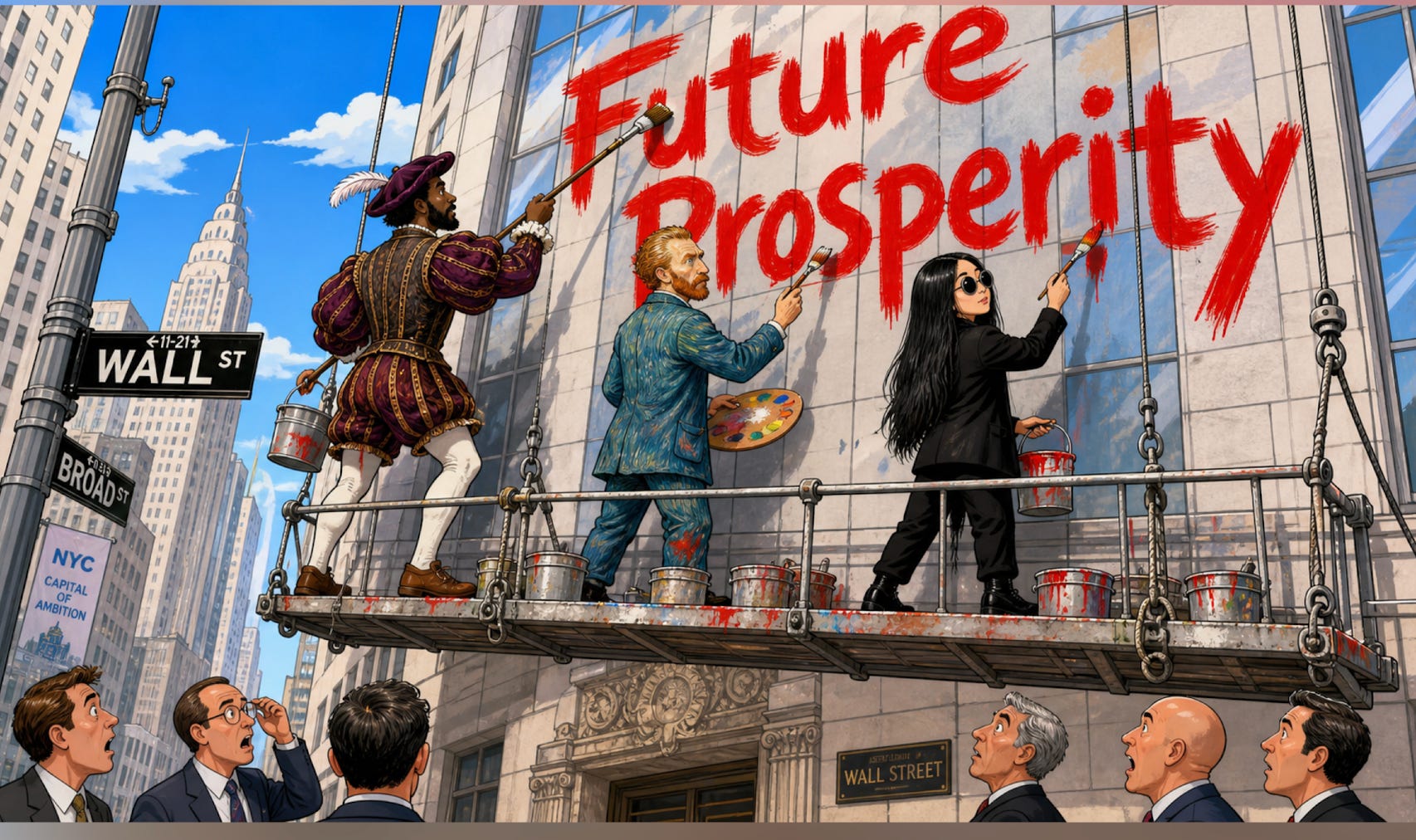
Designer talent is an artistic aptitude, and it is indispensable to the expansive AI future to which our knowledge economy, including the future prosperity it pledges to us, increasingly and pervasively is hitched.
Frontier AI companies at the same time have already quietly sidled up to the “post-logical” community of artists, humanists, and intellectual eccentrics.
Anthropic hired Amanda Askell, a philosopher from New York University whose doctoral studies examined the ethics of “infinite value”, to lead the team responsible for the “character development” of its leading edge AI platform Claude.
According to the tech blog Resume Whisperer, Askell developed “a training method that provides the AI with a set of principles to guide its behavior and allows it to critique its own responses based on those human-defined principles”.
Google DeepMind brought on Henry Shevlin, a philosopher of mind, and when Meta’s WhatsApp needed a new chief executive this summer, it turned to Kunal Shah, who studied philosophy rather than computer science.
Anthropic’s own president Daniela Amodei has explained that what her company looks for in a hire now leans toward communication, empathy, and aesthetic precocity for the most part because those qualities are becoming more valuable, not less, throughout the tech industry.
Steve Jobs made a version of this point fifteen years ago when he stood in front of a slide showing the literal intersection of two streets named Liberal Arts and Technology, and insisted that technology cannot advance on its own.
What has changed since 2011 is not the truth of that observation but the economic stakes overall. As one tech executive recently lamented to me privately, “we are now capable of computing everything and comprehending nothing.”
That is why Bedford’s closing argument at Bronze Buffalo made the impact it did, and why the two “shocks” Ryan referenced matter less, when all is said and done, than the collective capability of “reflective judgment” for which our thought leaders of tomorrow must be urgently outfitted.
Bedford christened that capability “wisdom” and summoned the room to roll up their sleeves and erect a magnificent new home for “critical thinking”, an environs within which mathematics and science can be enthusiastically taught alongside history, literature, philosophy, and religion.
I want to qualify that prescription with my own “judgment of taste”, or clever aside .
The specific competency, not to mention exigency, of a knowledge economy nowadays is not a demand for generic “critical thinking”, a somewhat hackneyed phrase worn down smooth by decades of curricular boilerplating.
What is genuinely desired for our critical “knowledge futures” is a widespread facility for reflective judgment in Kant’s special connotation, which has persisted for the longest continuous stretch of human history within the arts.
The future of the knowledge economy by this reckoning belongs to the arts in particular, and the humanities in general — not as a consolation prize for students who were unable to handle calculus, but as the authentic cipher that decodes human intelligence and, by extension, its artificial version.
As Bedford reminded us, it is the creative-destructive force behind civilization that has brought us to our present pass at which “wild human thinking has to dig up the next big idea.”
The AI capital cycle, which according to the New York Times is propping up the entire American economy, cannot be sustained much longer without a new momentum impart from the “next big idea”.
Bedford challenged us to think bigger and more boldly than we’ve ever thought before about the future itself.
The only question is whether we are really up to it.