
The grim financial reckoning of American higher education is now upon us
Yet a bold and courageous rethink of what the "college experience" really means can rescue it from disaster

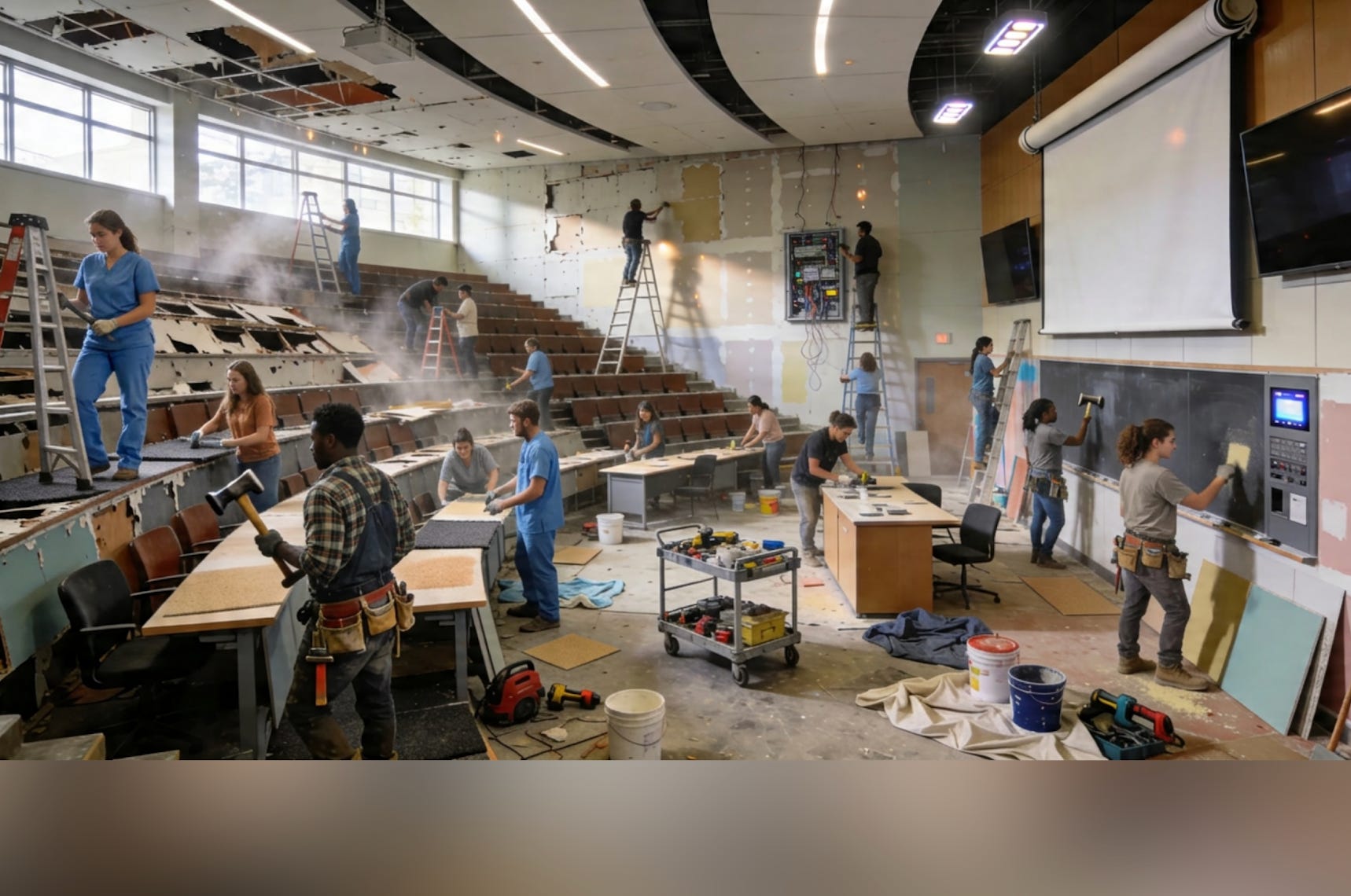
American higher education is in systemic free fall.
The numbers are alarming and unambiguous.
As a PBS news report warned last week, more than one fourth of private colleges are in danger of closure.
Postsecondary enrollment as a whole has dropped by 2.3 million students since 2010, largely because a severe downturn in the available supply of 18-year-olds since the Great Recession of 2008-09.
The percentage of high school graduates transitioning immediately to college from high school declined from 70% in 2016 to 61% today.
New visa issuances for international students paying full-tuition plummeted by almost 100,000 in 2025 alone, a 36% collapse in just one year.
The financial scaffolding that keeps much of higher education intact is rapidly deteriorating.
Private nonprofit colleges now return more than half of every tuition dollar as institutional grants. The 56.3% discount rate for first-time full-time undergraduates in 2024–25 is at an all-time record.
Aggregate student loan debt climbed to $1.833 trillion among 42.8 million federal borrowers. At the same time. the price index for higher ed rose faster than the pace of consumer inflation this past year.
The pattern, virtually all experts agree, is unsustainable.
The knee-jerk response among university administrations has been to make across-the-board cuts, which for the most part have impacted traditional humanities and adjacent liberal-arts disciplines.
Such a response, while seemingly a no-brainer, turns out to be completely, counterproductive, key research shows.
The leading educational research and consulting firm EAB found that 67% of institutions making large indiscriminate cuts saw expenditures actually grow faster in the years that followed.
Indiscriminate budget slashing, they reasoned, undercuts both productive and unproductive outlays and sabotages institutional capacity to generate revenue. Not only does it injure employee morale, it also triggers enrollment shortfalls that push per-student costs up even further.
The more important finding is something faculty and staff, who routinely bear the brunt of financial crises when they arise, have known all along.
Between 1993 and 2021, full-time non-instructional staff at American degree-granting institutions grew by 93%. Full-time faculty grew by only 53%.
Administrative bloat, not faculty salaries, is the primary driver of the cost growth in higher education that has far outstripped inflation.
The research on educational quality points to a short and consistent set of inputs that effectively change learning outcomes. They include the frequency and quality of interaction between students and faculty, well-designed peer learning, timely feedback on student work, curriculum formatted to support active rather than passive engagement, and early warning systems for students showing symptoms of disengagement.
None of these inputs are intrinsically expensive. What expands cost — and by extension has contributed in a way that most American prefer to ignore — is the brick-and-mortar delivery infrastructure built around them, such as buildings, residential facilities, and of course housing for the bureaucracy itself.
One conspicuous and unspoken causal factor covertly and cozily closeted away throughout the financial puzzle palace of American post-secondary learning is the physical plant required to guarantee the increasingly outmoded norm of “campus life” itself.
Higher education harbors its own dirty little secret, namely that classroom utilization across American colleges and universities averages below 60%. Office space utilization comes in around 20%.
The most compelling and realistic strategy for paring student costs while preserving educational quality is a shift toward custom-designed online delivery.
The sticker price for a private nonprofit four-year residential education is $65,470 per year. More than $20,000 of that covers housing, food, transportation, and personal expenses — expenses that evaporate entirely for online learners.
At public institutions, a 120-credit online degree costs roughly $14,000 to $18,000 in total against $261,880 at a private residential institution.
These numbers highlight the most significant access opportunity in the history of American higher education.
There are 36.8 million Americans with some college and no credential. For the vast majority of them, the high price of traditional residential education has been the overshadowing barrier to degree completion.
But historic alternatives to residential learning, while more budget-friendly, have in recent years lost much of their allure.
The prevailing modality through which online learning has been implemented in American higher education is “asynchronous”, consisting of recorded lectures available on demand, discussion boards that accumulate posts without authentic conversation, assignments submitted into a digital void with feedback arriving days later, if at all.
It is the very format that has produced engagement deficits, isolation effects, and elevated dropout rates documented throughout the post-pandemic literature.
Attrition in asynchronous online programs runs between 20 and 50 percent, roughly twice the rate of face-to-face curriculum. The same research is consistent on the causes, including absence of any felt accountability to a learning community and the collapse of motivation that follows when a student is alone with a screen and no one notices whether they show up for class or not.
However, the romantic ideal of the residential college experience is not holding up very well either. The sense of belonging that the campus experience is supposed to curate is measurably on the downswing even among students who are physically attendant.
A CDC survey discovered that only 55% of students felt close to people at their institution in 2023, down from 62% in 2021. One in five Gen Z students now plans to live at home and commute instead of residing on campus.
A Gallup survey ascertained that the share of high school students expecting to earn a bachelor’s degree has careened downward from 72% in 2002 to 44% in 2022. Among first-generation students the numbers plunged from 60% to 33%.
The generation for whom higher education has proclaimed it is reinventing itself happens to be the generation least convinced that the residential model performs to the degree it pretends.
What Gen Z does value is flexibility, career relevance, and appreciable interaction that is not merely transactional or expressive.
So-called “Zoomers” are digital natives who have lived their entire social lives through screens. The argument that physical co-presence is educationally irreplaceable does not persuade a generation that nurtured its closest friendships through social media platforms and spent two years of its formative learning period online during the pandemic.
What persuades Gen Z — and what the data increasingly confirms they are right to insist upon — is learning palpably connected to a conceivable future, which makes the circumscribed ivy-crusted campus less and less relevant.
Most institutions have made a critical mistake in presuming there are only two modalities in higher education.
There are actually three.
The third, or what has come to be known as “synchronous” online learning — live instruction conveyed through a variety of conferencing video platforms with sophisticated peer and faculty interaction in scheduled modules— is the one that the research most consistently recommends.
It is the one that most straightforwardly addresses the well-recognized failures of asynchronous delivery, although it is also the one that legacy post-secondary institutions have been most reluctant to invest in.
Synchronous online learning, or live instruction imparted through video platforms with structured peer and faculty interaction, is qualitatively distinct from other types of instruction.
Students and instructors occupy the same moment even when they cannot occupy the same space.
A study by Martin, Sun, Turk, and Ritzhaupt uncovered a statistically significant benefit regarding cognitive outcomes when it comes to synchronous online versus in-person means of instructional delivery.
The most rigorous real-world evidence comes from the system of California Community Colleges, where enrollment data from 2015 through 2022 showed that performance gaps between synchronous online and face-to-face student participation are on the whole significantly less than discrepancies between asynchronous online and in-person course offerings.
Finally, a landmark study by Francescucci and Rohani has demonstrated how purely synchronous online instruction produced student performance and engagement outcomes that are comparable to face-to-face modalities.
But solid educational research provides even more support for the thesis that colleges and universities need to retool dramatically in order to stay afloat with the next, imminent deluge of digital technics.
Artificial intelligence, as a central case in point, amplifies whatever educational advantages an institution might already flaunt. When deployed appropriately and consistently AI is largely a quality-enhancement instrument that can also generate cost savings.
An MDPI study published in 2025 found that AI-driven curriculum systems achieved course completion rates of 89.72% and retention rates of 91.44%, contrasting with substantially worse results for traditional models.
One European start-up company known as Shryn.ai is developing AI “avatars” of influential professors offering their “thinking” to the public at large, even when the real personae are not available for the public to pick their brains.
Carnegie Mellon’s Open Learning Initiative offers the most rigorous institutional case study. Students using OLI materials performed as well or better than traditional course students in half the time.
Another well-documented example is Georgia State University, whose GPS Advising system tracks over 40,000 students daily against 800 risk factors and intervenes before academic or financial problems become critical. Their system has yielded demonstrable graduation rate gains, particularly for first-generation students along with those eligible for Pell grants.
Moreover, the same students showed mensurable retention improvements among first-generation and Pell-eligible students, who disproportionately make up the “stop-out” population.
But AI cannot substitute for what is the interpersonal heart and soul of the higher learning. Human tutors achieved twice the learning benchmarks of AI agents in controlled experiments.
The implications for AI integration into the curriculum is precise. AI should be positioned as a demanding interlocutor requiring students to engage more rigorously with their own thinking, not as a placeholder for mindless task completion.
AI, whether it is introduced in industry or education, can never be conceived as a cost-cutting mechanism supplanting human discernment and ingenuity with impersonal algorithms.
But if applied in the correct manner and in a proper context it can boost the productivity of all dimensions of post-secondary learning and thus prove economically advantageous if inputs are ultimately correlated to outputs.
The way forward does not come down to a Hobson’s choice, usually defined as a “take-it-or-leave-it” proposition where leaving it is not really a possibility at all.
Indeed, it never has been such a choice.
New research from Rize Education surveying more than 1,500 students in January 2026 confirms what the enrollment data has been indicating for years.
Students refuse to be dragooned into opting between acquisition of the social capital and interpersonal connection that residential learning affords and the plain convenience of taking online courses.
They demand both.
And they are making enrollment decisions with that criterion in mind, turning up their noses at institutions still wedded to a one-or-the-other instructional paradigm.
What the future looks like is not a “hybrid” model in the reductive or additive sense — a sprinkling of online offerings to ease the burden for commuter students or those night owls who can’t bring themselves to get out of bed for an 8 am class.
What they seem to be longing for is a total makeover of what a university is, and what it is for.
In this vision the physical campus does not disappear, but contracts, intensifies, and translocates into pertinent spaces. It is sited according to its particular task or purpose rather than hugging the premises where it has been historically grounded.
That, in outline at least, is a vision nascent in a book of mine I published a quarter century ago.
In The Digital Revolution and the Coming of the Postmodern University (Routledge, 2000), I argued that the new online technologies did not constitute merely a delivery mechanism, but a force majeure that would compel a sweeping rethink of the university’s identity from the ground up.
The book was prescient in its expectation that the transformation would be structural, not cosmetic.
It was wrong, nevertheless, or at least it was premature, in underestimating the institutional inertia and self-dealing that would defer the reckoning all the way to the next generation, one which has now arrived.
What I did not foresee with sufficient clarity was the degree to which the “postmodern university” would not be a single institutional formation but a differentiated and imbricated ecology of what remains most valuable, trend-setting, and consequential for the next iteration of the world-compassing “knowledge society”.
The “iconic” residential college will persist into the next generation, catering to a clientele that can afford the full-blown immersive campus experience and whose social reproduction requires it.
But it will no longer serve as the normative prototype for the remainder of American higher education.
Like the European aristocracies of the late nineteenth century, it will percolate for a long while in the nostalgic wool-gathering of America’s power elite while growing profoundly irrelevant.
One would be foolish, if not downright idiotic, to proclaim the end of the university after the fashion of those “experts” in the early 1990s who proclaimed the “end of history”.
But we know the general template we’ve desperately clung to for all these years is no longer sustainable and has, in fact, seen its last years.
As Mark Twain famously quipped, “20 years from now you will be more disappointed by the things you didn’t do than by the ones you did”.
If we don’t act now, we may be more than simply disappointed.
We may be wandering and picking among the sad rubble of the much vaunted “knowledge economy” on which any affordable economic future desperately depends.