
The God we barely discern
Religion, the Iran war, and the total eclipse of the globalist fantasy

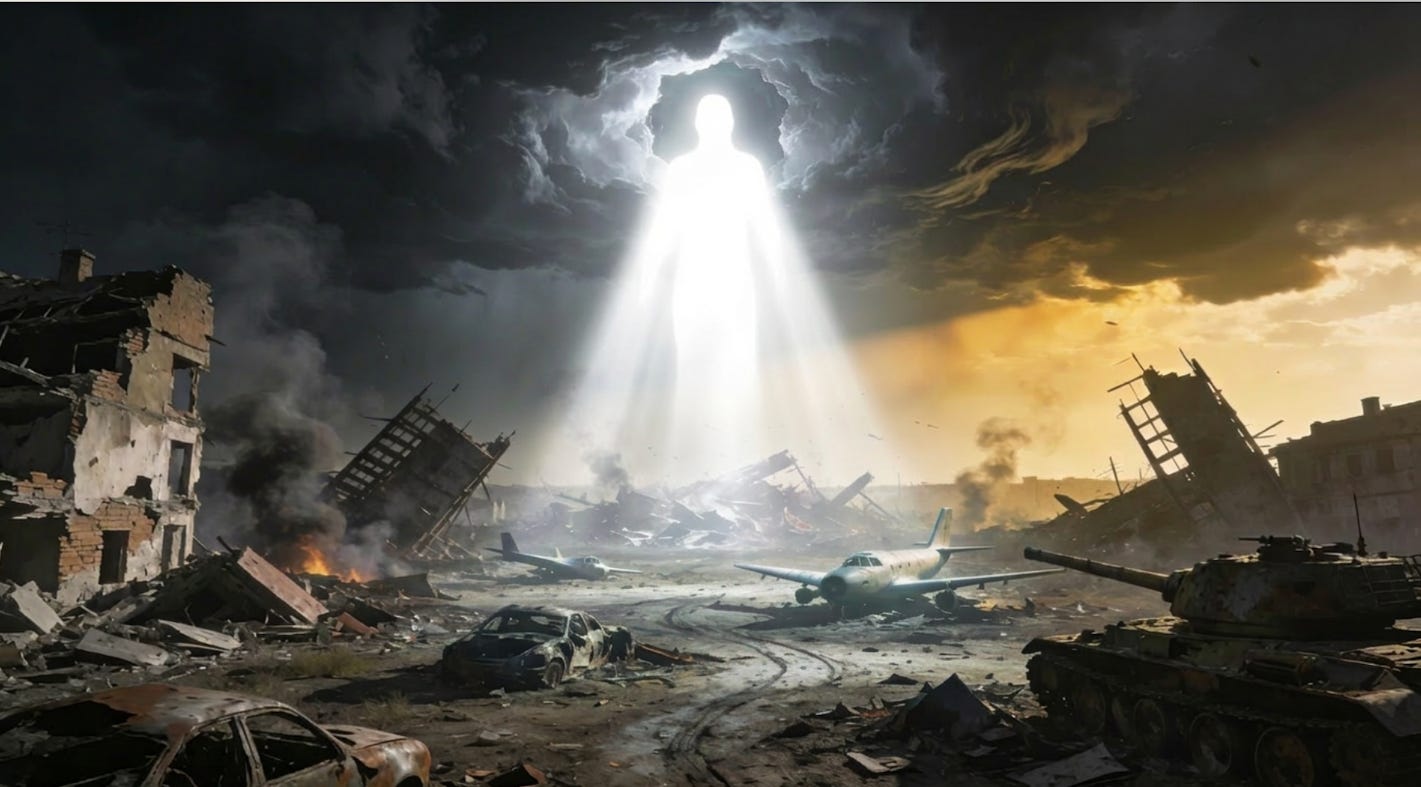
The Iran war has accomplished something that three decades of factious scholarship, armchair punditry, and the fever dreams of foreign policy rainmakers have managed to conceal.
It has accelerated in real time and with spectacular brutality the collapse of the Western world’s foundational myth of the post-Cold War era — namely, the grand illusion of a relatively concordant world interconnected through commerce, social exchange, and digital communications.
That myth — let us call it the globalist wager — has long held that economic integration and reciprocal reliance on advanced technologies would inexorably chip away at the ancient enmities of religion, culture, and civilization.
Trade would secure what diplomacy and military force had failed to make happen. The internet would magically conjure what missionaries and cultural ambassadors had been unsuccessful in achieving.
In short, we would finally witness a new age of flourishing among the crème de la crème of humanity’s benefactors without the unseemly and shameful legacy of empire, colonialism, and warmongering.
History, the celebrated political thinker Francis Fukuyama declared in 1992, was effectively over. Liberal democracy and market capitalism had won, and the remaining holdouts — Iran, Russia, China — would in due time slipside along with the rest of the world into a glorious secular confluence of material interests and ambitions.
Of course, the opposite has happened.
The “logic” of the world market has neither defanged nor domesticated radical Islam.
As September 11, 2001 drove home and October 7, 2023 painfully reminded us, radical Islam has leveraged the very communications nodes and linkages, not to mention the ever metastasizing “dark web” of off-the-books international finance, that globalization in the now defunct Fukuyama fantasy was destined to nurture.
The famed British historian Arnold Toynbee devoted much of his career to arguing that religion rather then economics, technology, or politics is the real motive force in world history.
In his monumental 12-volume work A Study of History Toynbee argued that civilizations are the vehicles through which humanity produces its “higher religions” — the rich, ancient heritages of transcendental insight and aspiration that are the most genuine and durable products of civilization.
Writing in 1955 Toynbee stated plainly: “religion has come, once again, to take the central place in my picture of the Universe.”
The mainstream secular academy dismissed this sentiment as mystical confabulation. Toynbee, nevertheless, was ahead of the evidence.
What we are witnessing now is not, however, a genial “Dialogue Among Civilizations”, a sanguine UN-sponsored vision of 2001 made public right after the World Trade Center disaster and ironically championed by then-Iranian president Seyed Mohammad Khatami, whereby the major religious traditions of the world would ennoble and come to understand each other through respectful conversation and collaboration.
Rather we are confronted with something far more termagant, more disorienting.
A quarter century after 9/11 we must come around to acknowledge that we are indeed caught up in what Samuel Huntington termed the clash of civilizations, the idea that future conflict after the Cold War would be driven less by beliefs or economics and more by cultural and religious identity, especially between large civilizational blocs.
Yet beyond beneath the “clash” something even stranger is percolating. The religious traditions implicated in the “clash” are themselves experiencing transformation.
They are simultaneously undergoing radicalization and in certain instances being hollowed out by the very processes that serve to configure them. The clash, once again, is not between stable, coherent faiths.
It is a war that is producing novel and even mutant iterations of what the befuddled scholars of “comparative religions” would blandly and insouciantly refer to as the “sacred”.
The morphing during the 1979 Iranian Revolution of a quietist, sectarian, and largely apolitical Shi’a Islam into a militarized quasi-totalitarian imperial state apparatus is an early and, at least today, quite consequential example of this wider phenomenon.
The co-opting of deeply embedded and venerated forms of religious practice by identity and tribalistic politics, as Matthew Schmitz describes in a recent op-ed for The Washington Post, is just the latest illustration du jour.
The Western cognoscenti continues to operate on the lazy assumption that religion is nought but a contingent variable to everything that is swirling across our current line of vision.
They are simply the blind stumbling after the blind.
The intellectual lethargy of the early 1990s was in retrospect breathtaking in both its presumption and its naivety. It is captured in an (in)famous remark by the Polish-British philosopher and sociologist Zygmunt Bauman.
The world…[is] starting to resemble a gigantic mall in which religion has become just one more stall where brisk sales of meaning are conducted, and where the customers are allowed to roam around freely, picking and choosing, trying on and discarding, with no obligation to buy or to stay faithful to their choices.
No single book captured this mood of the “global citizen” as mall rat more perfectly — or more embarrassingly — than Thomas Friedman’s The World Is Flat (2005).
The New York Times columnist argued that the convergence of the internet, outsourcing, and open supply chains had “flattened” the world while dissolving the old hierarchies of geography, culture, and national difference into one level competitive plain on which anyone, anywhere, could plug in and prosper.
The World is Flat was a book-length paen to the proposition that economic and technological forces were not merely reshaping the world but finishing it with a curtain-dropping flourish at “the end of history”.
Flamboyantly subtitling his book “A Brief History of the Twenty-First Century”, which was just dawning, Friedman gushed that globalization would iron out effectively the very last wrinkles of civilizational difference.
His metaphor was arresting, and the book turned out to be a runaway best-seller.
But the twenty-first century didn’t exactly turn out as Friedman envisaged. Two years after publication the American housing market collapsed and we spiralled into the Great Recession.
It was not merely the “end” of the “end of history”. It was the beginning of a new and violent “time of troubles” in history, to invoke Toynbee’s terminology.
China had been welcomed into the WTO in 2001 on the theory that economic liberalization would invariably lead to democratization.
Iran was engaged, sanctioned, and engaged once more on the smarmy premise that pressure and incentive would bend its brand of “Islamo-fascism” toward a rational interest style of political pragmatism.
Russia was treated as a contentious but ultimately pliable great power whose residual resentments would dissipate as its GDP increased.
Such considerations were not only tactical. They were metaphysical in scope.
They hinged on the secularist self-delusion that religious and civilizational values are in the last analysis fungible, if not negotiable.
The bankruptcy of the “end of history” hypothesis stems at its root from two unexamined “first principles” of geopolitics, as Raphael Dosson has underscored.
The first was that liberal democracy would propagate — and thrive — both organically and universally. The second was that liberalism per se would be embraced as the cosmopolitan framework for all moral and political calculations.
Neither proved to be the case.
China adopted market capitalism without democratic governance, demonstrating that, in contrast with the conventional wisdom of the period, the two are not necessarily joined at the hip with each other.
Iran and Russia doubled down on civilizational chauvinism precisely as their economic assimilation into the Western sphere of influence advanced.
As for Western civilization as whole, it began to fracture and unwind internally as a consequence of deepening self-doubt, promoted and popularized by its own touted intelligentsia, about the scandalous mismatch between what it had practiced and preached during its historic rise to global eminence.
As James Hankins put it in a 2019 tome chronicling this misadventure:
The West has come to doubt its own civilizational inheritance because of the corrosive effects of its own success in propagating the critical spirit, the spirit of free inquiry and self-criticism that is the hallmark of its civilization. This spirit has led to the exposure and widespread dissemination of knowledge about the West’s legacy of slavery, colonialism, and capitalist exploitation, which were integral to its rise to global dominance. The Renaissance humanists themselves, in recovering the classical past, inadvertently sowed the seeds of this self-doubt by revealing the contradictions between the ideals of liberty and virtue they admired and the brutal realities of empire and servitude that made Western prosperity possible. Today, this internal critique has intensified, leading to a kind of civilizational masochism where the West questions its legitimacy, viewing its achievements as tainted by original sins of oppression.
Huntington foresaw the crisis in the near term, even though he was maligned considerably.
Huntington grasped what the globalists, whose covert agenda was always downplaying the role of the West, could not bring themselves to admit — that religion, and the moral infrastructure of human sensibility it anchored in concrete, would be the fundamental source of future turmoil as well as the sole path forward.
“Islam has bloody borders,” Huntington wrote, as of course does Christianity.
And those borders are blood-spattered precisely because what is at stake is not consumer nirvana, “affordability” — as the latest pop political mantra runs — or even AI-driven job discplacement, but the meaning, purpose, and the proper ordering of human existence.
As Nils Bilman has observed in an essay in Foreign Policy, until very late in the historical drama did anyone ever presuppose otherwise. Perhaps our present moment, according to Bilman, is most appropriately conceived therefore as “the revenge of Huntington.”
The bequest of the modern West radiates from the value proposition that individual autonomy, informed self-governance, and the separation of religion from public life are “self-evident”, as Thomas Jefferson would have phrased it.
The Islamic Republic of Iran in deference to its own customary reading of the Qur’an has all along fabricated its institutional architecture on the equally self-certifying principle that God’s sovereignty is total, that divine law is the only legitimate scaffolding for social order, and that the secular West is not merely politically obtuse but cosmically rebellious.
Putinism in Russia fuses Orthodox Christian identity with imperial revanchism and an abiding conviction that the liberal West’s cultural exports carry within themselves the pathogen of spiritual corruption in lieu of of the leaven of emancipation.
China under Xi holds up a Confucian cum Marxist model of civilization that explicitly rejects Western-style democracy as unsuited to its historical identity.
So far as the war against Iran is concerned, the theocracy believes, as Soror Shaiza notes in a jab at Fukuyama, it is “being asked to surrender its sovereignty, its ideology and ultimately its identity”.
Having evicted God from its own public philosophy, the secular West has largely lost the capacity to think seriously in those terms that remain “existential” for other governments and societies.
Which brings us to Toynbee’s “time of troubles”, a time that all the signs now point to.
Toynbee identified the “time of troubles” as a recurring pattern in the history of civilizations.
The “time of troubles” is a period of prolonged crisis during which the dominant minority loses its creative capacity, existing institutions fail to meet major historicalchallenges, and social disorder spreads.
In the crucible of chaos, Toynbee remarked, societies respond in one of several ways — “archaism”, or the attempt to monumentalize a romantic past; futurism, or “techno-utopian escape”; or the emergence of something authentically new and unparalled from the wreckage of the old.
Radical Islam in general, and the Islamic Republic in particular, are the clearest contemporary examples of Toynbee’s archaic response. Putinist Russia follows a close second.
But the liberal West itself increasingly resembles Toynbee’s dominant minority in late-stage crisis.
The Iran war, however it resolves itself militarily, will not in the long run make that much difference. It is instead intensely symptomatic of a crisis of civilization itself that will outlast any single administration, any single ceasefire, any single peace deal.
Toynbee believed that out of the flotsam and jetsam of disintegrating civilizations, a “universal church“ — his term, deliberately diffuse and non-sectarian — or a radical, new signature of global spirituality would materialize, perhaps unexpectedly and in a form or figuration no one can easily call up in the mind’s eye.
We are not at that stage — yet. We are now in a trajectory of apprehensive descent rather than exuberant ascent.
What arises from the vapors of ground zero will be the inheritance of Generation “Not Yet”. But impact is nearer than many acknowledge.
In the year 1966, in what became one of the most haunting philosophical obiter dicta of the twentieth century, Martin Heidegger sat down for an interview with the German magazine Der Spiegel, which it published posthumously five days following his death in 1976.
Asked whether philosophy could still move the needle of world history, Heidegger replied:
Philosophy will not be able to bring about a direct change of the present state of the world. This is true not only of philosophy but of all merely human meditations and endeavors. Only a god can still save us.
What Heidegger discerned and diagnosed was the spiritual vacuity at the core of Western modernity.
“God is dead,” as Nietzsche’s “madman” had announced a century earlier, and no human ideology, theology, or political project could fill the void.
The god whose arrival might save us could not, he insisted, be summoned by any human petition or effort . We could, at best, ready ourselves for the deity’s appearance, or for the same god’s persistent — and perilous – absence.
The West now confronts adversaries for whom martyrdom in the service of their version of God is not a failure of rationality but its highest expression. This asymmetry applies not just to the battlefield but to the inner convictions of the belligerents.
The crisis of the moment is not merely that the West has turned away from God.
It is that every tradition currently embroiled in combat is fighting in the name of a god that is in Toynbee’s deepest sense a diminished god — a god who legitimates idolatrous authority rather than confronting it, a god of “collective egotism” (as the great “crisis theologian” Reinhold Niebuhr expressed it) rather than, in the words of John the Revelator, a God “who is, and who was, and who is to come, the Almighty”.
The question really comes down not to whether a god can save us, but what kind of God are we expecting to do so in the first place?
The only God who can save us is the God we barely discern, the God who waits to be made fully present amid the crackup of all our sanctimonious secular and conventional religious certainties, the God who makes no concession to our clamor for comfort as well as our refusal to commit to what we know needs to be done, or endure what is coming.
The God we barely discern can, in fact, be called upon if we have eyes to see and ears to hear.
Only that God can truly save us!