

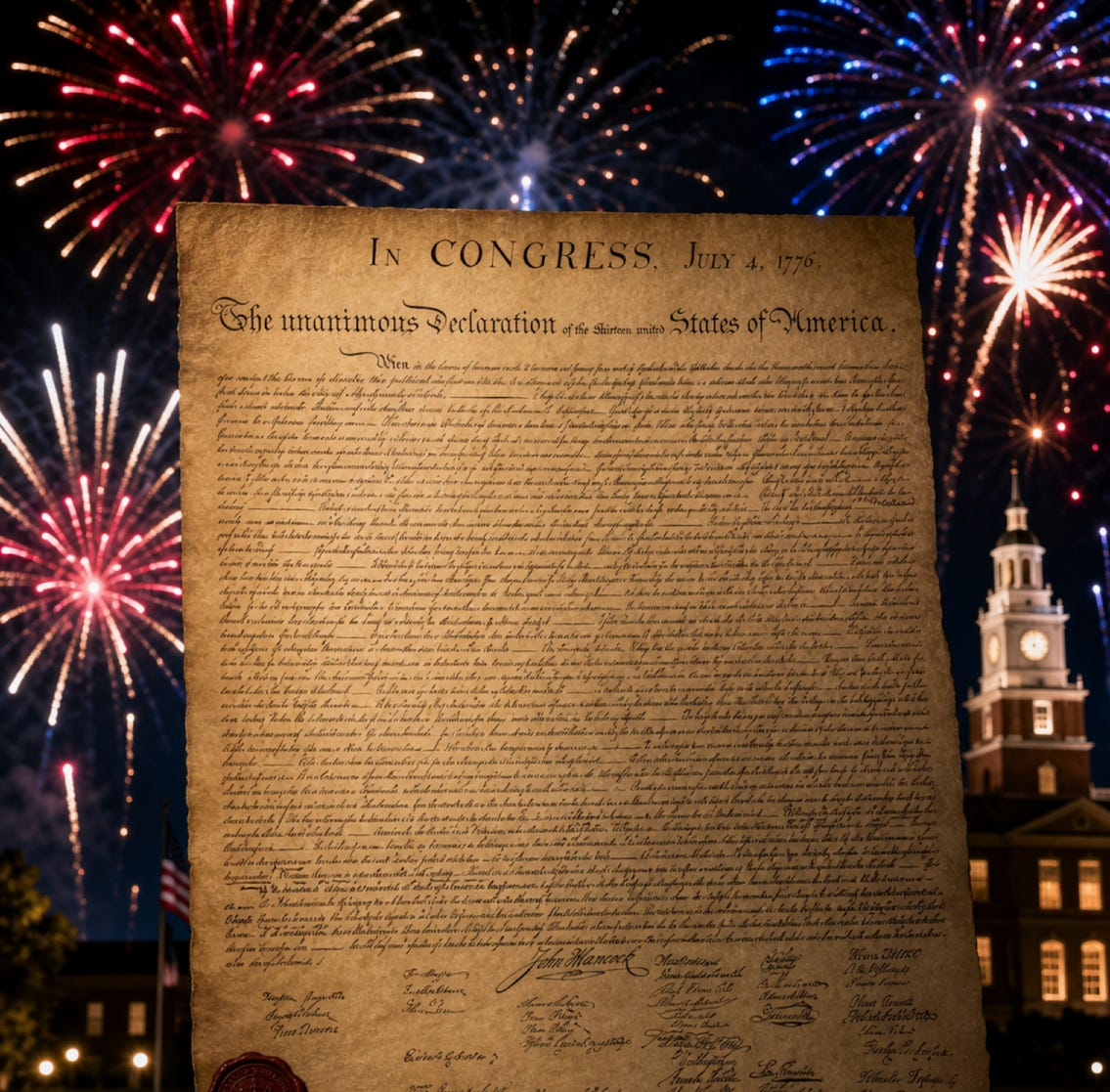
The Fourth of July fireworks have flamed out, the bunting is folded away, and the semiquincentennial that commandeered a year of planning has transited from fraught anticipation to cloyed memory.
It is a fitting moment, therefore, to ask ourselves the very question the celebrations themselves always tend to defer until the “next time around”.
After two hundred and fifty years, do we really know what we were actually celebrating, or will celebrate, when the tri-centennial arrives in 2076, should the republic survive that long?
The question is not an idle one. The United States of America has reached the 250-year milestone in the midst of a contentious pushback from its cognitive elites about whether the founding it consecrates is an achievement to revere, a wrong to reckon with, or a matter too confusing to reduce to either.
By most measures the majority of Americans still regard the country and its legacy as well worth commemorating.
A survey by the Cato Institute found 79 percent proud to be American and 86 percent grateful for it with roughly three-quarters viewing the founding of the nation favorably. Regardless of the mood swings of the commentariat, the average American still honors the project, so far as they latch on to it.
But at the periphery of the larger consensus a second pattern has been gestating for more than a decade, and it can no longer be discounted or waved away. National pride, as Gallup records, has slipped to its lowest point in the quarter-century the firm has posed the query — 58 percent “extremely” or “very” proud in 2025, down from approximately 90 percent after September 11.
The decline is not evenly distributed. It is concentrated sharply among the young, specifically Gen Z or those born between 1997 and 2012.
Averaged across recent years of polling just 41 percent of Gen Z reported being proud to be American in contrast with 58 percent of millennials, 71 percent of Gen X, 75 percent of Babt Boomers, and 83 percent of the Silent Generation. A separate 2026 survey tracked the same gradient by age, with barely half of adults under 35 calling themselves patriotic.
Scholars who study Gen Z attribute the shift partly to a school curriculum that for younger Americans has dwelt more on the nation’s failures than on its virtues. According to these researchers, our youth comprise a generation taught from elementary through graduate school to look with a jaundiced eye on the familiar narratives about America’s founding narratives rather than to double down on them.
The unease is not only about pride but about the future of America. An analysis by the Public Religion Research Institute (PRRI) survey captured the sentiment straightaway with more than two-thirds of Americans saying the country is in stark danger of relinquishing key democratic rights and freedoms.
PRRI claims to be “non-partisan” and neutral, but outside bias-rating sources deem it left-leaning.
Whatever the cause, a durable and growing constituency who are disproportionately young has concluded that America is not worth the hype. That narrative — or perhaps “anti-narrative” —deserves to be taken seriously, if only because it is because an ascendant trend that could easily go mainstream.
Case in point. No one in the waning years of the Obama administration expected burgeoning right-wing populist memes to transmute into a political force majeure that would elevate Donald Trump to the presidency.
The “anti-American” anti-narrative has gained electoral voice through the insurgency of Democratic Socialist candidates recently elected to public office, who are well-nigh guaranteed election come November after having ousted long-tenured Democratic office holders in solid blue urban districts.
New York sent Zohran Mamdani, a Democratic Socialist, to City Hall last fall, and his endorsed slate then dispatched entrenched incumbents in June primaries throughout the boroughs of New York City.
A week later Colorado — a historically purple, once largely libertarian state — delivered its own surprise when a 29-year-old Democratic Socialist unseated fifteen-term congresswoman Diana DeGette in Denver, and state senator Julie Gonzales captured 43 percent of the vote against sitting U.S. Senator John Hickenlooper in the Democratic primary.
President Trump, in his Fourth of July address reflexively denounced the trend as what Karl Marx himself characterized as the specter of “communism”.
The Democratic Socialists of America reject that label. Most DSA-endorsed officials campaign on the recognizable goals of what in Europe is commonly known as “social democracy” — for example, housing, health care, a shorter work week, political objectives more closely associated with Copenhagen than with the Comintern.
To simply call the DSA agenda “communism” flattens real distinctions and almost autonomically conjures up the cliché of “red-baiting” during the McCarthy era, while making it easy for us to avoid reading between the seductive and deceptive lines to discern what the “democratic socialists” really have in mind.
The DSA was in fact founded in 1982 as an avowedly democratic and anti-Communist current of the American left by Michael Harrington, a writer, professor, and political activist.
For its first three decades DSA remained a small advocacy group of a few thousand, mostly older members whose strategy was to work inside the Democratic Party and pull it leftward rather than to overturn the constitutional order. What makes the present moment notable is how far it has shifted from that origin.
In the wake of Bernie Sanders’s 2016 campaign the membership of the DSA swelled from roughly 6,000 to more than 100,000, a base now overwhelmingly young and college-educated.
Its strategy switched from reforming the Democratic Party toward building an independent force. Revolutionary Marxist caucuses gained ground in its national leadership, and the “labor Zionist” strand that was central at its inception gave place to the officially anti-Zionist organization it is today.
And yet the label of “communist” for the DSA is not purely gratuitous, insofar since the movement’s own documents have tended to sound at times lately very much like the rhetoric of Marx and Engels themselves.
DSA’s official 2025–2026 program states that its aim is to put workers in charge “through a new democratic constitution,” one built on a single legislative chamber that would abolish the Senate. Its revolutionary Marxist Unity Group wants socialist leaders to “erode the popular legitimacy of the U.S. Constitution,” which it calls the “slaveholder constitution”.
A different caucus describes itself frankly as “Marxist-Leninist”, and editorials in the movement’s flagship magazine Jacobin call for a constituent assembly to supplant the constitutional order rather than reform it.
A movement, of course, can be more moderate than its manifestos, and often is. But when the manifestos propose to abolish founding charter of the United States and draft an entirely new version, the critic who takes the DSA at its word is not to be dismissed as some sort of crackpot or conspiracist.
Given that history shows us how political polemics — think Weimar Germany or Cuba at the end of the 1950s — that is initially disregarded as inflated or inconsequential often proves to be a fateful miscalculation, the claim that the DSA is nothing more than a fuzzy and well-intentioned European-style social democracy is, to put it mildly, totally bogus.
What Mamdani famously referred to as the “warmth of collectivism” in his January inaugural speech should give anyone pause if the still doubt implication.
There is a further reason to weigh the word “democratic” carefully in the way DSA deploys it, and the concern can be traced directly to the movement’s commitments abroad. Over the past two years the DSA has aligned itself more and more explicitly not just with the Palestinian cause, but with the armed Islamist cadres that champion it — organizations whose own politics are neither democratic nor socialist.
The record is not in any sense equivocal.
On October 7, 2023 the national organization issued a statement of solidarity that declined to name or condemn Hamas, attributing the massacre to justifiable blowback against Israel’s “apartheid regime.”
The following summer, after Israel killed the Hamas leader Ismail Haniyeh and a Hezbollah commander, the DSA’s International Committee mourned them as “martyrs” and pledged solidarity with their “popular resistance movements.”
Not only has the committee has defended Iran’s right to “self-defense” as the theocratic patron of both groups. It has also gone so far as to condemn support for Israel’s right to self-defense as an expellable offense.
When a Gaza ceasefire was arranged in late 2025, the DSA denounced it as insufficient and reaffirmed its backing for ongoing “resistance.”
DSA members in response have maintained that they condemn the killing of all civilians, Israeli and Palestinian alike, and the group’s statements often include such language. But the alignment with global Islamism has incurred certain costs.
The historian Maurice Isserman, an inaugural member of the DNA, quit in protest, writing that a movement which cannot condemn a pogrom has forfeited the right to call itself “democratic socialist”. About two dozen members resigned along with him.
The point is not that American socialists are covert theocrats. It is that a politics claiming the mantle of democracy has increasingly made common cause with movements — Hamas, Hezbollah, the Iranian regime — that execute dissidents, subjugate women, and never hold honest elections.
That is indeed a strange alliance for any organization whose first name is “Democratic,” and it perhaps speaks more about the moral compass of a generation who increasingly appears enamored with its platform.
All of which forces us back to our initial conundrum.
If an expanding cohort believes the American project, however they might perceive it, is not worth affirming, then we are obliged to inquire what the American “idea” has really been about all along at any rate.
Do both the triumphalist platitudes of the conventional right and the lazy, fulsome posturing and lumpen-Marxist sloganeering of the hardcore left miss the mark about the meaning of what we are suppose to memorialize on the Fourth of July with a much wider pass than anyone might suspect.
Consider four scholarly books that have been written about the not-so-obvious significations of the Declaration of Independence, the archive we nominally sanctify.
Pauline Maier’s American Scripture argues that the Declaration was not a timeless statement of abstract values, but a piecework of historically contingent politics, hammered out in committee with multiple revisions on the part of the Continental Congress, that became “canonical” only years later.
Garry Wills’ Inventing America advocates for the view that Jefferson, author of the Declaration, did not so much follow in the tradition of the English political philosopher John Locke by proclaiming the “inalienable” rights of “life” and “liberty”.
Rather, Wills insists, Jefferson was a fanboy of Adam Smith and the Scottish Enlightenment, in effect construing the text as a charter of reciprocal moral responsibility and social interdependence.
David Armitage in his book The Declaration of Independence reads the document as the template that a hundred later nations would subsequently adapt for their own claims to political independence and sovereignty.
Danielle Allen in Our Declaration finds in its sentences a performative act of equality. She explains it as a text that engenders the very standard by which Americans could later judge their own failings, which is precisely what Frederick Douglass did when he asked what the Fourth of July signified for the slave.
What these accounts have in common is a proposition that should unsettle both ideological camps.
The vision of America was never a singular, burnished, and perspicuous notion handed down by angelic overlords to humanity from on high. It was a view of common life that was endlessly drafted, negotiated, emended, transcribed, and reinterpreted.
From the very start it was heavily freighted with seemingly irresolvable tensions between liberty and subjugation, equality and property, consent and order.
The complexity of the nation’s aspirations and its own heritage of heroic storytelling was framed both at the starting gate and two and a half centuries thereafter. The framers imagined an order capacious enough to be heatedly contested as well as debated, an artifact to be perpetually refashioned and updated rather than a glistening heirloom to be admired.
Madison’s system of divided powers and rival factions in keeping with classical design principles of balanced reciprocity was purposefully put in place so that no single political “solution” could ever dominate.
Which means that Americans who feel they do not fully understand what they were celebrating are in one sense quite right.
We do not thoroughly comprehend the “idea” of America, and we were arguably never supposed to do so, because the national project is forever a work in progress, even after 250 years.
And yet the controversy has delivered something that not truly in dispute. Whatever we cannot define about the meaning of America, we can certainly measure its results.
After two and a half centuries the outcome is indisputable. The United States remains the most powerful and prosperous nation on earth, and not in any constricted connotation of the word.
It produces the world’s largest economy — roughly 32 trillion dollars in 2026, more than a quarter of global output and greater than the next several economies combined. Its citizens earn a per-capita income near $86 thousand, which is among the highest of any large nation and the largest in the G20.
The United States outspends the next six or seven countries put together on defense, and in 2026 its military budget crossed a trillion dollars — a reach no rival approaches. Its currency underwrites global trade, and its universities and corporations lead the world in technological advances for the age of AI.
Finally, the persistent vector of human migration is toward U.S. borders, not away from them.
Of course, these statistics come with certain disclaimers. American debt is skyrocketing. Inequality in America is the highest in the G7, and dominance is not the same as virtue.
Power and prosperity do not by themselves address the moral paradoxes of America, both contemporary and historical, that remain rife throughout the country’s trajectory, (e.g., the brutal abuse and removal of its indigenous inhabitants, racial exclusion and segregation, and so on), and it would be a petulant kind of patriotism to pretend otherwise.
Yet a nation that has been cartoonishly typecast by its adversaries, domestic and foreign, as somehow the global axis of human oppression does not become, let alone remain, for a quarter of a millennium the “city on the hill” where migrants by the multimillions, as Emma Lazarus in 1883 so eloquently put it, are “yearning to breathe free”.
The American idea, regardless of its persistent ambiguity and ambivalence, has shown itself to be unrelentingly enduring, inherently adaptive, and incommensurately productive when it comes to human flourishing.
So as we pack away the fireworks, let us ponder the prospect that even if we do not fathom specifically what we have been celebrating, a sizable majority of us still find it worth igniting our Roman candles and marveling at the “rockets’ red glare” in the darkening sky above us.
Why?
Because the epic of America is in some weird way of thought processing the story of all of us taken not separately but together, whoever we happen to be, and however we came to be here.
That is the real story we tell and retell for next fifty to a hundred years.