

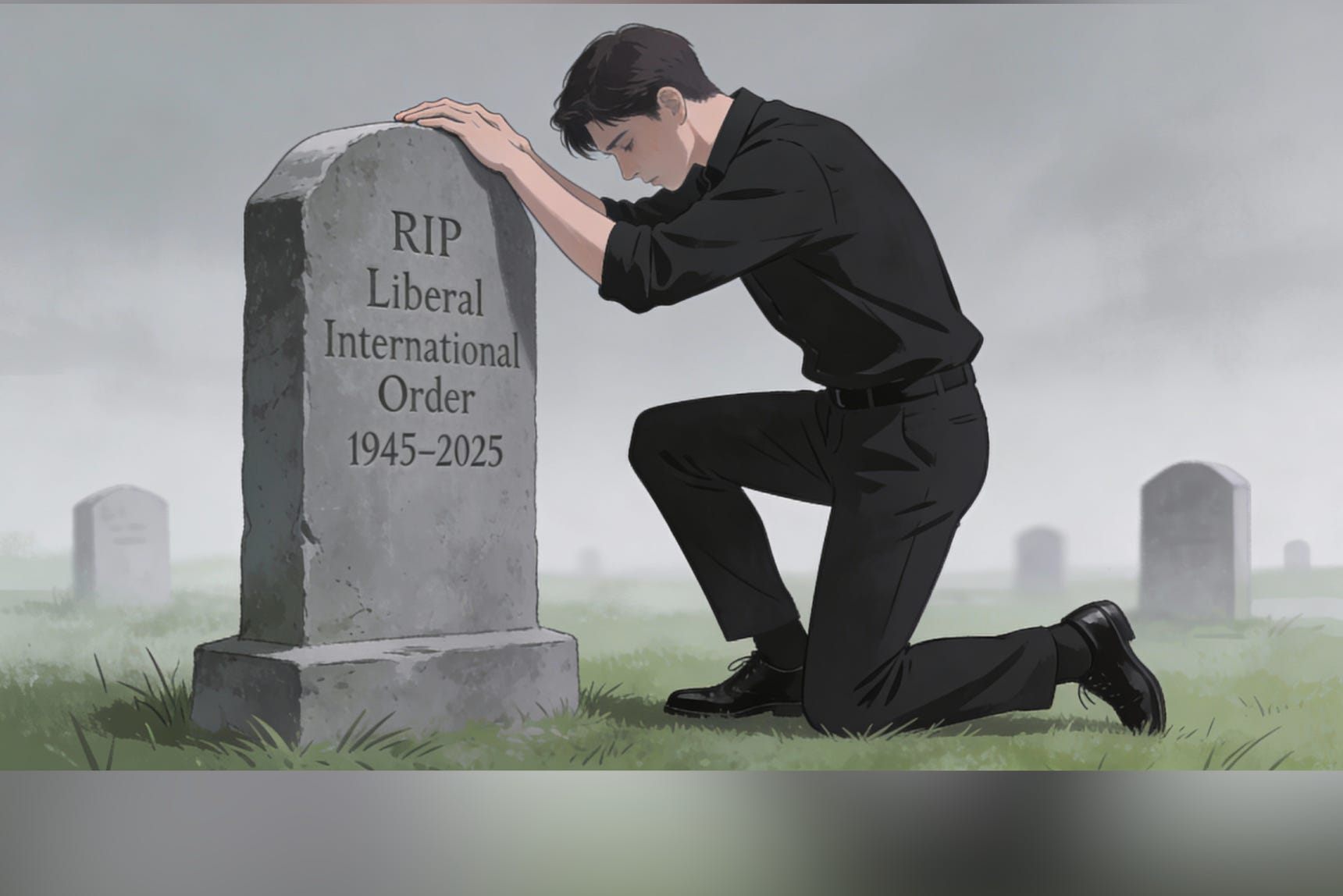
Is the much vaunted “rules-based” international order now dead? Or on its death bed?
The signs are everywhere.
On Friday United Nations General Secretary António Guterres warned that the pre-eminent international governing body was in danger of “imminent financial collapse” – a prospect that has never been seriously raised since its establishment more than eight decades ago.
The second coming of Donald Trump’s Presidency, reviled by the mainstream press as a “chaos agent” who has broken the Atlantic Alliance and revels in gunboat diplomacy, along with the rise of populist movements around the world have ignited intense debate about the future of the global liberal – or she we say “neoliberal”? - order.
Mainstream news commentators and political scientists have routinely pointed fingers at Trump’s “America First” agenda as well as nationalist leaders from Budapest to Brasília as the culprits responsible for the accelerating disintegration of decades of international cooperation, free trade, and multilateral institutions.
Yet this narrative, while convenient, fundamentally misread the diffusive dynamics of a globalized world itself. Those who blame Trump, or populism, or “authoritarianism”, or “fascism” – throwaway epithets for self-important, cognitively challenged, slogan-spraying, ideologically inebriated, think-bots - remain snared in the sugary delusion that the very post-war liberal order that has nurtured the very affluence that has enabled them to secede from the real itself was somehow permanent and self-perpetuating..
The “inconvenient truth”, as Al Gore once labeled it, is that the liberal international order, like all civilizational arrangements prior to it, was begotten from specific historical circumstances and was forever destined to evolve or dissolve as time marched on and circumstances mutated.
The German historian and philosopher Oswald Spengler understood the seasonal rhythms of civilizations with remarkable prescience and clarity.
In his monumental work The Decline of the West Spengler argued that cultures and civilizations go through organic life cycles, transitioning from birth through maturity to inevitable decline. He wrote that “every culture has its own civilization...Civilizations are the most external and artificial states of which a species of developed humanity is capable.”
For Spengler, civilizations necessarily ossify, losing the vital creative energy of their cultural youth and becoming taut, mechanistic systems that inevitably exhaust themselves.
Viewed from a Spenglerian angle the liberal international order is not coming apart because of Trump, or Marjorie Taylor Greene, or Republicans tout suite, or commensurate populist interlopers, but is simply reaching the conclusion of its natural lifespan, its internal contradictions, and rapidly changing historical conditions that have left it unsustainable.
To grasp why the current order was never permanent, we must acknowledge its deeply contingent origins. The liberal international order was never somehow what political theorists would call the “state of nature” from which everything now is devolving.
It was rather a specific response to the catastrophic failures of global governance during the initial half of the twentieth century.
After two devastating world wars and the Great Depression demonstrated the perils of unrestrained nationalism and economic protectionism, America in partnership with European leaders constructed a system designed to prevent such disasters from recurring. The Bretton Woods institutions, the United Nations, NATO, and the General Agreement on Tariffs and Trade emerged from the unique “civilizational” precarity of the year 1945.
A unscripted update took place in the early 1990s following the sudden collapse of world communism, but it wasn’t until the turn of the millennium and a set of new debacles – what the social and economic theorist Nassim Taleb dubbed “black swans” - that the old world was unraveling and a strange new one percolating inside it.
Crucially, the old “liberal” order was only ever partially liberal and never truly global. From 1945 until the fall of the Berlin Wall, the world was split into competing spheres, with roughly half the planetary population living under totalitarian communist regimes that explicitly rejected liberal economics and liberal democracy.
The liberal international order operated primarily within the Western bloc—North America, Western Europe, Japan, and their allies. Even within this sphere of influence, the system relied heavily on American military and economic dominance, not the uniform embrace of liberal norms by equal partners.
The Pax Americana underwrote the global political and economic system and in implementation it was effectively more imperial than multilateral.
The neoliberal turn in the 1980s and 1990s - the shift toward deregulation, privatization, and financialization - intensified ingrained contradictions that are now speeding the collapse of neoliberal globalism as we know it.
Economist Dani Rodrik has articulated what he calls the “fundamental political trilemma of the world economy”. According to Rodrif, we cannot simultaneously have globalization, democracy, and national sovereignty. We must choose two out of three.
The neoliberal project attempted to square this circle by privileging hyperglobalization while constraining democratic governance through international agreements and institutions that insulated economic policy from popular pressure.
Neoliberalism generated extraordinary wealth for some while creating devastating dislocations for the rest. Between 2000 and 2010 alone, the United States lost approximately 5.7 million manufacturing jobs. Economists David Autor, David Dorn, and Gordon Hanson have shown that the “China shock” of import competition accounted for a major share of this decline.
Meanwhile, financialization transformed the economy in ways that concentrated wealth and power. As celebrated economist Thomas Piketty has documented, the return on capital has consistently exceeded the rate of economic growth) in recent decades, leading to spiraling inequality.
Mark Blyth, another leading global economist, has argued that austerity policies imposed after 2008 essentially delegitimized the neoliberal order in the eyes of millions, if not billions. Rather than acknowledging that deregulated finance had precipitated the crisis, political elites insisted that ordinary workers acquiesce to pension cuts, wage freezes, and truncated public services to pay for the sins of bankers.
The “Great Recession” of 2008-10 proved to be the Achilles heel of neoliberalism and the beginning of its ending. Neoliberalism required continuous legitimacy through prosperity, but it failed spectactulary.
All the while that economic contradictions hollowed out the neoliberal world order from within, the emergence of a coordinated “axis of resistance” among so-called “authoritarian” states such as China, Russia, Iran, and North Korea challenged it externally in a manner inconceivable during the unipolar moment of the 1990s.
These highly militarized regimes forged what amounted to what amounts to a counteralliance, united not by shared ideology but by mutual opposition to American hegemony and the liberal international norms that sustained it.
The ascent of China proved that liberalism was not a vital prerequisite for development. But over time China moved beyond merely exploiting the liberal trading system. It began aggressively challenging its strategic architecture.
According to a 2023 report by the US Department of Defense – now the “Department of War” - China’s military modernization has led to the People’s Liberation Army Navy operating the world’s largest fleet by number of ships. China has also developed anti-access denial capabilities specifically designed to counter American power projection, and it has expanded its nuclear arsenal significantly.
Perhaps most critically, the United States itself - that resplendent paladin and guarantor of the liberal order—is fragmenting internally in ways that make continued global leadership increasingly implausible. Americans now occupy two mutually equal and hostile spheres of reality, with a combative and violent politics that amounts to low-intensity civil war. This hyperpolarization is not merely partisan disagreement but reflects fundamental incompatibility in how Americans understand their country, its legacy, and its prospects.
The traditional narrative blames right-wing populism almost exclusively for this breakdown. But this autonomic reflex of the chattering classes obscures a more complex situation.
Left-wing “populism” has become just as, or recently even more, disruptive, particularly among what sociologist Musa al-Gharbi terms “symbolic capitalists” - the “knowledge class” of journalists, academics, consultants, and other credentialed professionals whose labor produces and manipulates symbols rather than material goods.
These white-collar workers have experienced their own status anxiety and economic precarity, propelled an increasingly radical politics that mirrors right-wing populism’s intensity while embracing a caricatured vision of what “justice” might actually mean.
President Trump and recently elected New York City mayor Zohran Mamdani consist in bald personifications of these utterly converse social constructions of reality.
The economic guardrails that for several generations have ensured safe driving for this aspirational and hitherto prestigious, well-educated social cohort – what New Left theorists John and Barbara Ehrenreich in a famous 1977 essay dubbed “the professional managerial class” - are now dissolving before our very gaze, largely because of a twin juggernaut of “black swan” phenomena that have come into play quite recently.
These are the unaffordability, albeit the putative necessity of higher education,and the runaway downstream effects of artificial intelligence (AI), which in the view of John MacGhlionn “is gutting entire sectors with hurricane force”.
The bloated national debt, exceeding $38 trillion, constrains government spending that has historically subsidized many knowledge economy jobs in education, healthcare administration, and the nonprofit sector. Furthermore, artificial intelligence threatens to automate or dramatically reduce the value of cognitive labor that symbolic capitalists perform.
Just as manufacturing workers saw their bargaining power evaporate when their jobs moved to China or were automated, knowledge workers now face similar displacement. McKinsey estimates that generative AI could automate up to 30% of hours worked across the US economy, and will have outsize impact on precisely the educated, white-collar professions that have hitherto felt most secure.
This status threat has produced a radicalization among symbolic capitalists that manifests as an aggressive identity politics, institutional capture of universities and media organizations, and a quasi-religious hypermoralism that brooks no dissent.
The resulting culture wars over race, gender, history, and national identity are no longer mere epiphenomena, or distractions. Instead they reflect genuine “class conflict” in the Marxist sense over resources, status, and power. Each side views the other not as legitimate political antagonists, but as existential threat.
Universities, once sites of relatively open inquiry, have become ideological monocultures where deviation from progressive orthodoxy can end careers. A report by the American Council of Trustees in its introductory state laments:
There is nothing more central to the life of the mind than the robust exchange of ideas. In recent years, however, there has been increasing evidence that this exchange has been under attack and that, in many respects, the academy has become one-sided and coercive—indeed, even hostile—to a multiplicity of viewpoints.
Study after study has documented the politically one-sided nature of the faculty. And ACTA’s report found this imbalance to have serious consequences. Nearly half of the students at the top 50 colleges ranked by U.S. News & World Report reported significant political pressure in the classroom, nothing short of a direct attack on their right and ability to learn.
Media outlets function no longer as neutral information brokers than they do as partisan belligerents in a daily redoubling and exacerbated series of “culture wars”. The culture wars are simultaneously class wars.
Even more destabilizing is the doom loop dynamic between left and right populisms. Each side’s excesses provide justification and fuel for the other’s further radicalization. Legitimate right-wing grievances about cancel culture, promotion of open borders, institutional bias, and contempt from coastal elites drive support for increasingly extreme figures and policies.
Right-wing provocations then confirm left-wing narratives about racism, authoritarianism, and democratic backsliding, instigating ever more perceived “atrocities” that are framed by each side’s unyielding moral absolutism. The end result is a self-reinforcing cycle where compromise, let along dialogue or negotiation, becomes impossible.
An internal political fragmentation of America, therefore, subverts the country’s capacity to sustain the liberal international order. A nation which cannot even minimally agree on basic facts about its history, or its own elections, and which treats domestic political opponents as sworn enemies, and whose institutions are increasingly perceived as illegitimate in the eyes of swelling segments of the populace, cannot credibly promote democracy abroad or maintain global leadership.
The bipartisan foreign policy establishment that crafted and upheld the liberal international order ha been scattered to the four winds. Foreign policy has become nothing less than just one more front in the domestic culture wars. The economic resources necessary to maintain global order are consumed by domestic dysfunction
The second government shutdown in less than six months, this time over the enforcement of immigration policy rather than any serious disagreements over budget priorities, is a telltale reminder of how dangerously dyspeptic politics has become. As the renowned political scientist Francis Fukuyama warns, liberal democracies face a calamity of governance when peak polarization has set in.
It is a pitiful pathology of our politics today that a frustrated, but guileless electorate continues to vote over and over in turnstile fashion for one party over the next, and then vote back into office the very party they just rejected in the last go-round, in the tragic belief someone, anyone, or whatever candidate party awaits entry into the revolving door, can somehow fix America. But the problem is polarization itself. Every time we shift our vote we make the problem worse.
The same goes for our seemingly irrepressible instinct to blame one party for the state of the nation – and of the world.
We viscerally single out an “enemy” to point the finger at. But as the famous quip from the cartoon character Pogo goes – words that were quoted repeatedly during the Vietnam debacle two generations now ago – “we have met the enemy, and it is us”.