
Divided we fall
The perils of polarization in a war, despite our politics, we truly did not choose

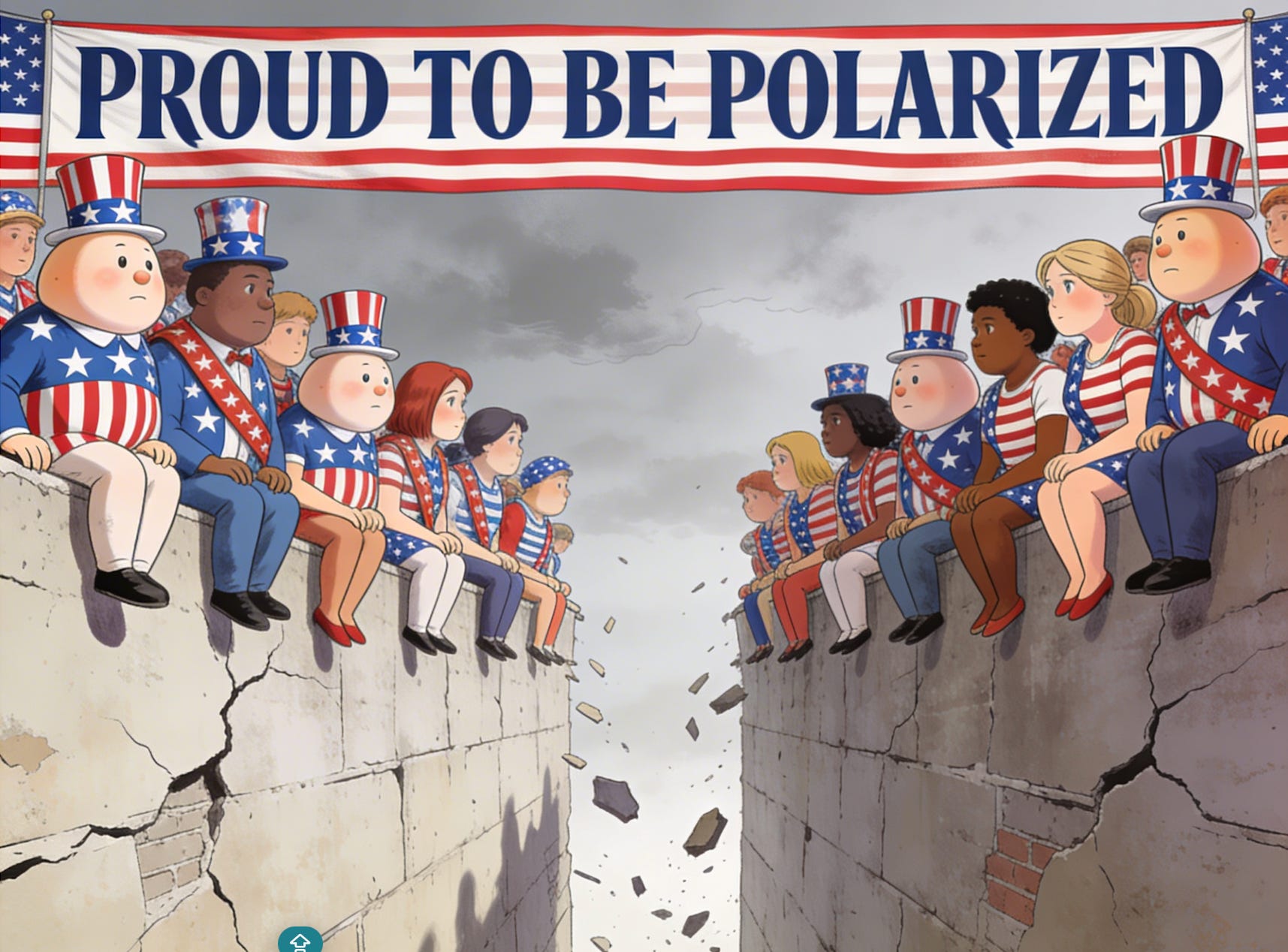
Here’s something the posh professional polarizers on cable television, on social media, and in the marble corridors of the Senate dare not even whisper to you.
Polling data released by Douglas Schoen and Carly Cooperman of Schoen Cooperman Research suggests the American electorate, when it pauses long enough to do a thoughtful double take, is not nearly as suicidal as its own political leadership.
Their survey of more than 800 adults found that while the country remains split on the U.S.-Israeli operation against Iran - 44 percent supporting, 41 percent opposed - two-thirds believe Iran poses a serious, if not an existential, threat to national security.
Furthermore, 78 percent support dismantling Iran’s worldwide financing network of terrorists and proxy fighters., whereas 72 percent support destroying its nuclear program.
We are not a country at war with itself over whether Iran is an outsize threat to ourselves. We are a nation neurotically conflicted concerning the semantics of our own divisive political rhetoric.
And that distinction is outsize as well!
We are not really arguing about whether the current Iran combat is a “war of choice”. We are quibbling merely about whether to call it one.
The war with Iran has never really been a war of choice. The struggle has been going on in fits and starts ever since November 4, 1979 when the newly empowered minions of an obscure religious figure with a Medieval mindset known as Ayatollah Ruhollah Khomeini stormed and ransacked the American embassy in Tehran and held 52 American hostages for 444 days.
The on-again and off-again conflict has been sustained over four decades by Iran arming, funding, training, and commandeering a broad-ranging, sleazy terrorist proxy circuitry from Beirut to Baghdad and Venezuela to Gaza.
In recent years the new “cold war” with Russia and China has meant that a more covert and sinister military “axis” has been waging its own stealth campaign against the West with Iran as its leading edge, according to the Carnegie Endowment for International Peace.
The initiative began with Russia supplying Iran with satellite intelligence and drone technology, while China made sure that maximum sanctions pressure would never quite be adequate.
As one insightful piece of news analysis this week made clear in chilling technical detail, Russia has been providing Iran with real-time feeds of American warship and aircraft locations - intel that allowed Iranian forces to achieve a targeting precision they could never have managed alone.
Moscow’s motive is quite transparent. Iran provided Russia with Shahed drones for deployment in Ukraine, and Putin is now returning the favor in spades.
China’s role is more clandestine, but arguably more congenital.
As the National Interest reported before the war began, Beijing had supplied Iran with sophisticated and advanced radar defenses, in particular a UHF-band system designed to reduce the effectiveness of radar-absorbent coatings on U.S. stealth aircraft.
The Caspian Post, meanwhile, has reported that Russia and Iran concluded a $589 million air-defense deal in December 2025. Russia began delivering 48 Su-35 fighter jets, equipped specifically with radars designed to detect stealth aircraft, as of early 2026.
Finally, CNN confirmed this week that U.S. intelligence indicates China is preparing to provide Iran with financial assistance, spare parts, and missile components.
In a word, Iran has not been fighting the United States alone. On the contrary, it has been aided and abetted by America’s own powerful sworn enemies.
The notion peddled by detractors such as Richard Haass that this was a “classic war of choice” relies on a curiously truncated timeline, one that conveniently overlooks how the Iranian regime itself declared war on “the Great Satan” in 1979 and has been prosecuting it through sundry feints and subterfuges the entire period.
The Defense Security Monitor documented that, following, the June 2025 “12-Day War,” Iran immediately sped up weapons negotiations with both Russia and China, even as international arms embargo provisions snapped back into force.
The Iranian regime all along has been racing to rearm for the next bout with the West.
The question was never whether a final reckoning would be upon us sooner than later. The “choice” was whether America would have a say in how and when the reckoning took place.
Otherwise, it would have to react to a catastrophe that was foisted upon us, as happened in December 1941, or in September 2001.
Alternate history game theory aside, what should be keeping every thoughtful American citizens awake at night, unfortunately, is the deep rot afflicting our political culture in the shadow of this war.
An article in the Washington Post on the reaction of young voters to the Iran War is a disturbing read, and not for the reasons the authors most likely intend.
Joshua Byers, a 26-year-old who voted for Trump in 2024 and now proclaims how he feels “betrayed,” also says he does not want to vote anymore.
A University of Chicago poll from December 2025 shows that approximately 6 in 10 young people have an “unfavorable” impression of both the Democratic and Republican parties. What we are watching is a controlled demolition of civic engagement in America among its youth.
Joe Rogan, who endorsed Trump after a legendary, long-winded podcast interview, called the Iran war “so insane” this week and declared as well that Trump had “betrayed” his supporters.
Yet here is where the same peril becomes downright poisonous.
Extreme polarization in wartime is a strategic liability of the first order. Combined with political apathy, it can distill into an insidious sort of witch’s brew.
The Carnegie Endowment has compiled the most comprehensive global study of what happens when democracies reach what they term “pernicious” levels of polarization. The United States, Carnegie observes, is the only advanced Western democracy to have undergone such intense polarization during the last three quarters of a century.
The report concludes:
Reducing the threat of pernicious polarization to democracy requires deliberate, urgent action. Or… American democracy itself may cease to be.
We are, as the report phrases it, “in uncharted and very dangerous territory.”
Political scientist James Piazza’s peer-reviewed research, cited by the War Prevention Initiative, found that across 83 democracies, heightened polarization correlates straightaway with elevated levels of political violence.
Polarization, Piazza concludes, “makes politics more dangerous.”
In their landmark study Democracies at War Dan Reiter and Allan Stam contend that democracies tend to triumph in the end because their reliance on public consent prompts them to become embroiled only in those conflicts they have carefully considered at length. Their soldiers enter into battle with more pronounced personal motivation.
The corollary, however, is just as impactful. Lack of broad consent for fighting certain wars, especially when they are messy and protracted, saps the natural advantage democracies hold over authoritarian regimes.
As legal scholar Harold Hongju Koh has pointed out, a polarized Congress confronted with severe security threats has an unfortunate incentive to “acquiesce” to executive power rather than exercise responsible oversight, thus depleting governmental accountability and fostering the style of tribal media theater that we are now seeing play out in real time.
There is truly an “existential” dimension to the crisis.
America’s political dysfunction is not just simply devolving in a vacuum. Our own global adversaries, who have the most to gain from our domestic enmity, are in many instances not simply exacerbating, but manufacturing it.
A report from Clemson University’s Media Forensics Hub, shared with journalists this week, identified 62 social media accounts across X, Instagram, and Bluesky that are linked closely with Iran’s Islamic Revolutionary Guard Corps (IRGC). The IRGC accounts masqueraded as Scottish separatists, Irish nationalists, and Latina activists from Texas and California.
For months before the war, these same accounts seeded inflammatory content tailored to the pain points of specific political communities.
The moment Operation Epic Fury was launched the accounts tout ensemble pivoted to anti-war propaganda. The accounts alone generated nearly 60,000 original posts on X that were reshared thousands of times and potentially reaching millions of Americans.
As Clemson researcher Darren Linvill put it plainly: “Iran redirected its resources toward propaganda around the war, trying to make the war more painful for the United States.”
During the early January protests across the Institute for Strategic Dialogue tracked nearly 800 English-language posts from Iranian-linked accounts, over 200 that originated in Russia, and more than 300 from China.
The messages from these hundreds of accounts were coordinated around the single narrative the uprisings in Iran were indeed a CIA and Mossad joint operation, that the United States is doing “Israel’s dirty work,” and that regime critics are traitors to the Muslim world.
We need, therefore, to contemplate the full architecture of what is actually transpiring.
The strife involving Iran is as much an “information war” as it is a kinetic one. The preferred term among black operatives these days, of course, is “cognitive warfare”, which spells out what is really at issue.
We are in a battle for our minds, and the American electorate is the principal target.
Of course, as far as the anti-war trolls are concerned, there may be just about as many in our own back yard.
Writing in the Wall Street Journal, pollster Mark Penn and Andrew Stein, former New York City councilman, sarcastically remark that within the American legacy media “only the bad news” is “fit to print”, and that “much of the news media seems determined to advance a [false] narrative that Mr. Trump is wrong about everything and that the U.S. is getting its clock cleaned by a powerful Iranian war machine that has successfully made the transition to new leadership”.
They opine:
Journalists have a right and a duty to report bad news and to question Pollyannaish reports from the U.S. government. But many seem to be going beyond that and rooting for America to lose—against an enemy that is the world’s biggest state sponsor of terror, that has killed thousands of unarmed protesters, and that stockpiled thousands of ballistic missiles while seeking nuclear weapons, which its rulers promised to use against the U.S. and Israel.
The “loyal” – and I use the term sarcastically - opposition for its part has largely chosen performance over substance, condemning the war without offering any serious framework for what a credible alternative would have looked like in a world where Iran was racing toward the nuclear threshold with Russian and Chinese technological support.
Taking into account the “big picture”, this war ultimately is not just about Iran. It is about the survival of even a flimsy semblance of democratic order in the face of a burgeoning and barbarous bloc of despotic behemoths.
The Persian Gulf is the contemporary battle front. Yet the musculature behind the actions of our adversaries is far more menacing than the conventional wisdom to which the cerebral reflexes of the residents of our present day political cloud cuckoo land can bend.
The young woman in the Washington Post focus group said she had come to believe the United States was “doing Israel’s dirty work.” That sentiment is precisely the narrative that Russian state media, Iranian IRGC propaganda memes, and Chinese diplomatic messaging have been spending billions to amplify.
It is also, as op-ed writers Michal Cotler-Wunsh and Nadav Steinman remark in The Washington Post, a screeching fire alarm that antisemitism, once an abhorrent bugabear of America’s elites, has now gone mainstream.
One does not need to be a conspiracy monger to make that point. Information environments affect us profoundly, as does the water we drink, the food we ingest, or the air we breathe. The same polarization eroding American civic commitment is being aggressively cultivated by adversaries who perceive it as a force multiplier more lethal than any missile.
It does not need to be dialed up, as it regrettably is nowadays, with all the round-the-clock slithery snark of our chattering classes.
The Schoen-Cooperman poll offers some hopeful signs. When Americans are actually informed about what the Islamic Republic has been doing all along, the atrocities it has perpetrated, or the evil which it has insinuated into the manifold of planetary body politics, a functional majority finds itself capable of coming to a striking consensus.
Seventy-eight percent are in favor of ending Iran’s terrorist financing. Seventy-two percent support eliminating its nuclear program. Fifty-nine percent support regime change.
Everyone hates war. War is not a video game, nor a Thursday night sports spectacle.
As William Tecumseh Sherman, author of the modern concept of total war, famously said:
It is only those who have neither fired a shot nor heard the shrieks and groans of the wounded who cry aloud for blood, more vengeance, more desolation. War is hell.
He also – less famously – said:
War is cruelty, there is no use trying to reform it. The crueler it is, the sooner it will be over.
Democracies have lost wars not because their militaries were outgunned, but because their publics lost the will to sustain them. Democracies lose their will to sustain them because they can no longer distinguish between what is, and what is not, worth fighting for.
The crazed Iranian regime, its Russian patrons, and its Chinese enablers know this well. I suspect the American people know it, but extreme polarization reinforced by bots and partisan grandstanding has rendered serious debate about what we are fighting for untenable.
It is one thing to rebuke the Trump administration for not explaining the war and its objectives, but one also has to cynically ask if it would make any difference anyway.
The “fog” of war is not the most invidious obstacle to reasoned, even if heated, debate. It is the thick, choking mist that lowers in the constricted cerebra of our ideologically fuddled and narcissistically obtuse politicians and media mahatmas.
The emerging consensus apparent in the polling data is, despite the raging hailstorm of disinformation, rather encouraging.
The quandry now is whether in a time of escalating war with the creepiest of creeps from the Middle East, no matter how we ever got to this point, the appointed institutional guardians of the 250-year-old American republic are responsible enough to fulfill their duties, or whether they will scornfully celebrate as the Great American Experiment goes down in flames.