
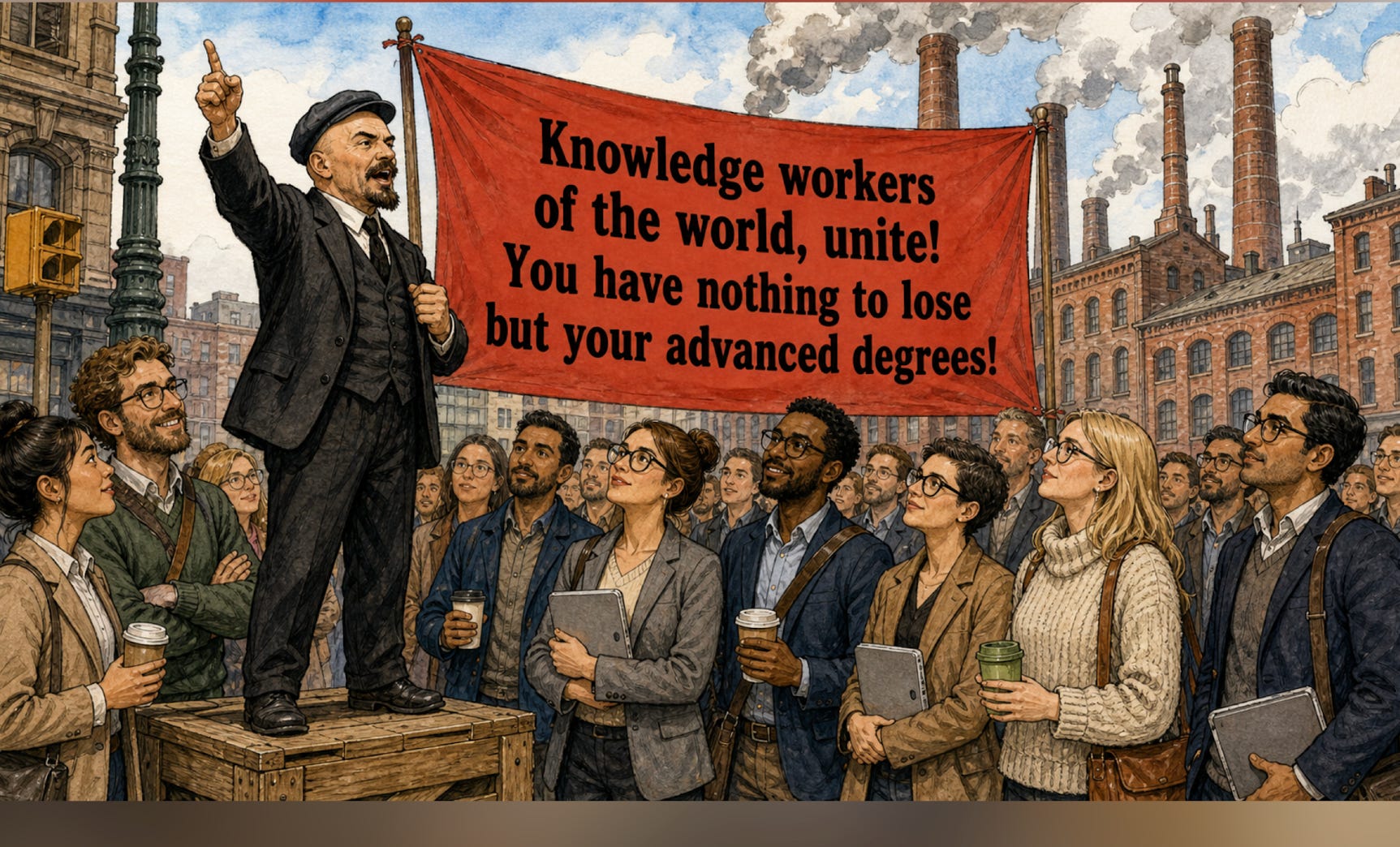
"Democratic socialism" is not really for the working class at all, but for the educated elites
And its platform can be easily unmasked as a subterfuge for propping up the failing knowledge production system that it has controlled all along

At the turn of the millennium the well-known sociologist Robert Putnam published a national best-selling book curiously entitled Bowling Alone: The Collapse and Revival of American Community.
Few outside of academia, however, could have foreseen that a quarter century later it would emerge as the signature diagnosis of American political dysfunction.
Bowling Alone documented in 2000 a phenomenon that at the time seemed troubling, but not in any way calamitous. Americans, it showed, were joining fewer civic organizations and attending even fewer community events.
The key indicator? Compared with the previous generation, the number of Americans bowling by themselves rather than in leagues had been declining at a precipitous rate.
Putnam’s fundamental thesis was far more momentous than its title alluded. He had chronicled the collapse of what had come to be characterized by his fellow social theorists as “social capital”— the intricate networks of mutual obligation, trust, and civic engagement that historically knitted American communities together.
Furthermore, Putnam had amassed data showing that the collapse was accelerating.
What Putnam did not completely anticipate was the way in which the atrophy of civic infrastructure would profoundly reconfigure contemporary American politics.
He was not sufficiently clairvoyant to envision a future present in which a working class had become increasingly untethered from the web of associations that at one time gave it a cultural voice alongside political power, while at the same time an educated professional class would have largely succeeded in controlling most civic institutions, which in turn had less representative of actual American interests or needs.
Today in 2026 the meteoric rise of what is fulsomely known as “democratic socialism” within American politics, particularly among highly educated young Americans and in urban professional enclaves, appears to convey a convergent social, political, and economic crisis.
Since 2025 democratic socialist candidates have increasingly used Democratic primaries to dislodge establishment officeholders while expanding their representation in New York’s state legislature.
They include not only Mayor Zohran Mamdani of New York City but also a slew of recent interlopers who won Congressional primaries such as Melat Kiros (Colorado), Darializa Avila Chevalier (New York), Claire Valdez (New York), and Brad Lander (New York).
Yet the crisis to which the democratic socialists and the progressive punditry routinely pretend to address — what Karl Marx in the 1840s referred to the “immiseration” of the “working class” — is in the final analysis a specious one.
In truth, it reveals itself to be a serious crisis of what the celebrated management theorist Peter Drucker in the 1960s dubbed the “knowledge class” — the professional and managerial elite whose economic and political positionality is now simultaneously menaced by the technological disruption of AI along with a broader backlash against progressive institutional capture of cultural identity, or what is commonly known as “wokeness”.
The irony is striking.
The trendy political movement that self-identifies as “democratic socialist” contends it is championing the cause of the laboring class, while in reality it functions as a muscular apparatus by which the educated elite is able to consolidate control over education, culture, and even economic opportunity itself.
As Thomas Edsall notes succinctly in The New York Times, “most of the leadership of the DSA. and a majority of voters who back its candidates are in no way working class”.
The key representatives of the movement all along have cornered the very social advantages that have fostered wealth inequality over the past half century.
Putnam’s Bowling Alone testified to the fact that involvement in civic organizations — for example, labor unions, fraternal orders, veterans’ groups, churches, community associations — had crumbled dramatically since the 1950s. Between 1975 and 2000 alone American civic participation plummeted almost 50 percent.
As civic institutions eroded, members of the working class were deprived of the traditional systems of sodality through which they had historically organized and advocated for their political interests. Labor unions declined from 35 percent of the American workforce in the 1950s to less than 10 percent by 2000.
Fraternal bodies, local political auxiliaries, and community support systems that had served as vehicles for working class empowerment and mutual assistance summarily vanished.
Second, and equally important, the educated professional class, which had begun to cement its institutional hegemony within universities, nonprofits, government agencies, media organizations, and think tanks, were inexorably insulated from the dangers of civic disintegration.
The knowledge class, or what social critics Barbara and John Ehrenreich in 1977 labeled the “professional managerial class” (PMC), still retained their own accoutrement for societal and reputational authority through which they could wield ubiquitous “soft power”. What they lacked was accountability to anyone outside their sphere of influence.
While working class Americans perceived the diminution of civic endowment as abandonment and disempowerment, the educated professionals experienced it as liberation. They were no longer constrained by the necessity of preserving their legitimacy through wider institutional validation.
They could pursue their own interests without any effective democratic guardrails. This process, which I have analyzed in my 2019 book Neoliberalism and Political Theology as the ideological consolidation of what Foucault called “biopower” through credentialed professional intermediaries, represents the transformation of democratic institutions into mechanisms of what sociologists would call “elite reproduction”.
Now fast forward to 2026.
According to a CNN/SSRS poll released at the end of July, 34 percent of Democrats and Democratic-leaning adults now identify as “democratic socialists.”
This statistic overlays what other pollsters have detected as a generational shift in the identity and aspirations of younger educated Americans. The rise of headling-hugging political figures such as Alexandria Ocasio-Cortez, Rashida Tlaib, Cory Bush, and others explicitly affiliated with the Democratic Socialists of America (DSA) suggests that socialism is, as Wall Street Journal columnist Peggy Noonan puts it, “not a passing thing but an arriving thing.”
But what is really up for grabs in the presemt democratic socialist moment?
A careful reading of the actual policy preferences and stated goals of DSA-affiliated and DSA-adjunct politicians and activists reveals a sizable self-contradiction within the movement itself.
The principal demands of the DSA center not on redistributing wealth to working class constituencies, but on lengthening the already extended reach of the professional managerial class in overseeing the economy in a manner that overwhelmingly aggrandizes them.
They seek:
· Universal healthcare administered by government bureaucracies — in other words, staffed by the PMC.
· Universal higher education, expanded and professionalized.
· Burgeoning social services requiring social workers with advanced degrees.
· Heightened climate action administered by technical experts..
· Gender and racial justice initiatives commandeered by DEI professionals.
In virtually every instance the major beneficiary of such policies is not the working class but – you guessed it –knowledge workers with a paper trail of advanced educational certifications.
This is not to say that democratic socialists are nothing more than polished charlatans . Rather, their growing clout underscores an argument that the German political economist Wolfgang Streeck has repeatedly made, namely, that the “cosmopolitan identitarianism of the leaders of the neoliberal age” has merely vacuumed up the rhetoric of working class advocacy while hyporcritically advancing elite interests.
As I myself have argued in my book, the genius of “progressive neoliberalism” — a term coined by political scientist Nancy Fraser to describe the world view of the Democratic Party since 2000 — was to the language of liberation, equality, and justice into subterfuges for legitimizing dominance by the professional in-crowd over social institutions.
Progressive democratic socialism represents the latest and most devious, not to mention duplicitous, iteration of this transformation. With all its semantic shape-shifting and cleverly crafted double entendres the parlance of working class championing morphs into an effective tool for enshrining knowledge class gatekeeping.
What has happened to post-secondary learning during the last quarter century is a choice illustration .
Higher education, which democratic socialists claim to want to make “free” and “universal,” has proven to be the premier mechanism through which wealth inequality has gained momentum over the past fifty years.
As both college grades and minimal metrics for credentialing have been inflated (example: employers offering positions that called for only a high school diploma now instist on a bachelor’s degree), the cost and time burden for the average job-seeker has escalated correspondingly.
The upshot is that only the wealthy can afford the unpaid internships, post-graduate training, geographic mobility, and the kind of credential stacking that the present day professional careerist relies upon.
A first generation college student from a working class family must either take on extraordinary debt, or forgo advanced study entirely. The parents of a wealthy student, in contrast, absorb the costs and supply the social capital that transmutes credentials into real-world opportunity.
The immediate response of the credentialing mafia to this structural inequity has been remarkably consistent. They demand more schooling, more documentation of performance, more licensing.
Each extra charge given to the certification syndicates means that those already embedded in the system as a whole —university faculty, administrators, accrediting organizations—raises barriers for working class entry.
Democratic socialists propose to make the current predicament worse, not better. By making higher education “free,” they would likely do what has occurred in every other sector where credentialing has burgeoned.
They make it obligatory!
If college is free, employers can demand a degree as their baseline requirement. Someone from the working class who cannot, or will not, travail four countless years in the credentialing hamster wheel becomes permanently unemployable in the professional economy.
The workers who balk at a “free” college education will find themselves competing against millions of equally commissioned peers, forcing wages down while dilating further the time and expense that must be set aside for formal learning.
Educational economist Bryan Caplan has extensively analyzed the “signaling” function of educational credentials. The degree communicates a willingness on the part of the credentialed to comply with authority and ability to delay gratification more than it evidences actual knowledge or skill.
When everyone has a degree, the degree itself no longer is an index of actual competence or skill advantage.
The push toward ever more superfluous credentialing has been the clear and consistent trajectory of higher ed over the last sixty years, and it is not incidental that the attained educational levels of self-designated “democratic socialists” is disproportionately higher than for most other political organizations, as DSA’s own membership survey stresses.
Furthermore, a recent Pew study found that the number of Democrats favoring leaders who identify as “democratic socialists” rises with income. According to Pew, 40 percent of upper income Democrats report liking such leaders, compared with 34 percent of middle-income and 24 percent of lower income Democrats.
Economist John Steele Gordon, writing in the Wall Street Journal, makes the case that America’s historical wealth creation has derived for the most part from innovation and expanding productive capacity, not on aggregating existing assets or embargoing opportunities for entrepreneuship.
Yet our contemporary educational system frequently pushes talent in the latter direction.
Throughout the 1950s one could often become an engineer, accountant, teacher, nurse, or manager with just a high school diploma and a dollop of on-the-job training. Criteria for entry were low. Skilled workers could access professional wages and status. Today, however, each one of these professions demands a diploma and increasingly post-graduate study.
Minimum career qualifications have gone up not because actual employment standards have soared, but because of credential inflation.
According to a report by the Harvard Business School, degree inflation is caused by an oversupply of college-educated job seekers, which paradoxically constricts opportunity for young graduates once they attempt to join the workforce.
“Degree inflation”, the report notes, “denies…young adults access to the critical first job and erodes the likelihood that they will gain the experience needed to enter and stay in the workforce”.
In other words, the very promises of a “free” college education, which the DSA has dangled as a delectable sugar plumb in the sight of youthful voters from the knowledge class to rally their support, happens to be the very poison pill that could foreclose their own economic future.
The “working class interests”, therefore, that “democratic socialists” and legions of political progressives purport to be fighting for are a manifest sham.
Their true aim is to protect the educational gatekeeping system that has been effectively in place for a long time and has propped up the interests of the professional class, which are now in light of the latest “great transformation” (in the words of famed Hungarian economist Karl Polanyi) of the global economy in unmistakable jeopardy.
As I explored in a recent essay on higher education and artificial intelligence, the three pillars sustaining historic educational gatekeeping — information scarcity, assessment monopolies, and credentialing cartels — are being simultaneously demolished before our eyes by AI technology.
Given the internet, students no longer depend on structured curricular content to access information. AI tutoring provides personalized instruction at a fraction of the cost. Work competencies can be attested through portfolios rather than through institutional certification.
The current financial, not to mention the credibility, crisis of higher education is ultimately a crisis of the business model that historically has buttressed the growth of the knowledge economy. Its impending downfall could inevitably leads to the demise, if not the crash, of the knowledge economy itself.
Unfortunately, that is not bare conjecture.
And, thus, the present moment happens also to be one in which the quickening revolution in artificial intelligence becomes most germane to any attempted anatomy of the current crisis.
For the first time technology threatens to make credentialing economically obsolete.
When an AI system can perform legal research as well as a lawyer, audit accounts with the same aptitude as many an accountant, diagnose diseases with the comparable expertise of a radiologist, and teach concepts with the equivalent sophistication of a professor with a PhD, the credentialing industry as a whole is called into compelling question.
AI liquidates the three pillars upon which the gatekeeping function of higher education has rested — information scarcity and the proprietary role of assessing cognitive and intellectual proficiencies.
These developments create an unprecedented opportunity for working class economic advancement. If the precious piece of parchment become economically irrelevant, or at least less consequential, then roadblocks to professional development for those without college degrees disappear.
Yet this state affairs serves to explain as well why the knowledge class is panicking. The ascendancy of democratic socialism is not au fond about working class empowerment but as a point of fact a case of the educated elites scrambling to harness state power in order to preserve their privileges in the face of technological disruption.
The proliferating calls for regulating AI, ensuring its “ethical” deployment, requiring credentialed oversight of its applications, and passing stringent laws to mitigate its environmental impact can in certain contexts be easily decoded as well-meaning, albeit self-interested. strategems to deflect the technological juggernaut that is remaking the knowledge economy overnight.
The working class itself would ironically gain tremendously from allowing AI to discombobulate the system of credentialing.
Real working class emancipation in the age of AI would not necessarily result from making access to higher education more affordable for everybody. It would accrue from peer-based assessment of capability rather than institutional certification.
Moreover, it would accrue from the creation of community-based learning centers not managed by professional gatekeepers.
Most radically, it would lean on repairing and reconstituting the civic infrastructure that Putnam lamented as having eroded in post-industrial society, all the while reclaiming the associational networks and social capital that once proved to be the political and economic mainstay of the working class in general.
Some municipalities are beginning to grasp the urgency of such a makeover. In certain regions alternative models are beginning to emerge — for instance, community colleges that focus on the curation of actual competencies, local maker spaces, and “skill guilds” where talent is taught and recognized by day-to-day practitioners rather than authenticated by formal accreditors.
National organizations such as the Competency Based Educational Network (C-BEN) have gone out front in promoting initiatives and experiments along these lines. AS C-BEN states on its website:
We use competency-based and skills-first approaches to build new systems, connecting learning to job performance and, ultimately, to economic opportunity. And because our solutions work, we scale them across the field—so that skills are the bridge between learning and work, even as jobs and industries change.
AI can also be instrumental in these cases. A venture known as Sophia Nova with a target clientele of under-resourced two-year colleges proclaims that it is seeking to “build the communities where faculty, students, and AI collaborate and think together”.
These models paint a picture of what a post-credentialist economy might look like.
The most pressing question is whether such models can scale before the DSA minions successfully co-opt the AI disruption and reimpose the wealth-choking bureaucracies that are bound to keep the working class in permanent serfdom.