
Cole Allen and the "benignity" of evil
The covert religious grammar of America's new political violence

Elizabeth Terlinden had a simple question when she learned that Cole Allen — the 31-year-old, Cal Tech-educated gamer and computer nerd from Torrance, California, who allegedly stormed a security checkpoint at the White House Correspondents’ Dinner armed with a shotgun, a pistol, and three knives — was her former co-leader of the Caltech Christian Fellowship.
Why would the guy she knew to be deeply Christian plot to kill the president? she is reported to have asked.
It was, she hoped, a case of mistaken identity.
It was not.
In fact, her question betrayed the bewilderment of someone who had studied the Bible on a weekly basis with Allen, had argued with him over whether to send charity dollars overseas or to local homeless shelters, and had known him as someone for whom doing “his duty religiously and morally, regardless of personal consequences”.
How does a brainy and cloyingly devout young Christian arrive at the conclusion that assassinating the President of the United is okay?
Allen’s manifesto supplies the answer straightaway.
Anticipating the objection that a Christian should “turn the other cheek” while clumsily mimicking Thomas Aquinas, Allen offered his rebuttal as follows: “Turning the other cheek when someone else is oppressed is not Christian behavior. It is complicity in the oppressor’s crimes.”
Furthermore, Allen opined, his decision to go down that road was not merely a difficult one. It was agonizing to the nth degree.
‘I want to cry for all the things I wanted to do and never will, for all the people whose trust this betrays,” Allen gushed in the first half of the second to the last sentence of his manifesto.
Those words, which on first glance appear to betray the inner turmoil of a double-minded and distraught young man, have been profusely parroted by the mainstream media.
However, it is the second half which virtually all media outlets have conveniently omitted in their excerpted coverage of the manifesto itself.
It is the particular sentiment, one which Allen interjects after a semi-colon, that transparently illustrates Allen’s real motive, former President Obama’s fulsome denial notwithstanding: “I experience rage thinking about everything this administration has done”.
In its own disturbed rationalization of what he had done, however, Allen can be construed as perversely miming the high-minded, but agonizing ethical decision of famed 20th century Christian theologian Dietrich Bonhoeffer to join in the conspiracy toward the end of World War II to assassinate Hitler.
Bonhoeffer’s decision was agonizing because he believed the plot to kill Hitler was morally wrong. Yet he also thought refusing to act in the face of mass murder would be an even worse sin.
As a highly regarded scholar of Christian ethics Bonhoeffer accepted the burden of guilt for a necessary act of “resistance”, choosing responsibility over personal innocence. He did not present assassination as “good,” but as a tragic, culpable action undertaken to save others.
But we need to be unequivocally clear here.
Trump is not Hitler, even if that seems to be the prevailing and apodictic opinion on the political left these days and has odiously and deliriously been received on college campuses as an incontrovertible truism, any cross-examination of which can trigger blowback of Stalinesque intensity.
Full disclosure — last fall I was pilloried on my course evaluations in the most nasty tone by a group of students, who also complained to the administration about my presumed transgression of having once remarked in passing that “Trump is not a fascist”.
Sidenote — I was simply trying to explain what the term “fascism” meant.
I also pointed out that under actual fascism martial law is enforced with jack-booted brutality everywhere and always (sorry, ICE is not a counterindicator), constitutional rights are summarily suspended, concentration camps are overflowing with political prisoners, and mid-term elections never happen.
You choose.
Now back to Cole Allen.
The psychologists who study what happens to people after they leave high-demand religious environments call it “deconstruction” — an expression that in an age long forgotten (i.e., the last quarter of the last century) was birthed amid the more esoteric ethers of French post-structuralist philosophy and had absolutely nothing to do with the connotations routinely buzzing around it in today’s popular culture.
Clinicians, though, have a more precise term — “religious trauma syndrome”.
Both phrasings amount to the same phenomenon, that is, the profile of an individual whose full cognitive and emotional apparatus remains intact after the doctrinal content of their strict religious upbringing has been rejected and are presently searching for a new view of the world to which the same general psychic formation can somehow attach.
The research regularly shows that people do not typically emerge from this transition as skeptics, or moral relativists.
They end up as veritably the same personality whose capacity for absolute conviction is thoroughly undiminished and whose predilection for cosmically staked moral argument is, if anything, magnified by loss of its original object.
The overwhelming majority of these “ex-vangelicals”, as they are commonly known, find a substitute zealotry in progressive politics, online community, and the offense-driven and confirmation-biased ecosystem of social media.
For a quite miniscule number such as Allen the outcomes can turn sinister rather abruptly.
Allen’s father has served as an elder at Grace United Reformed Church in Torrance, California, a congregation affiliated with the United Reformed Churches in North America (URCNA). The URCNA is not your grandmother’s evangelical megachurch with its praise band and felt-tip Jesus.
It is a theologically rigorous, confessionally demanding denomination that broke away from the Christian Reformed Church (CRC) in the 1990s precisely because it held that its parent denomination was not stringent enough.
For instance, it thought the CRC was too tolerant of women’s ordination and too willing to accede to what its founders viewed as apostasy when it comes to bedrock Reformed theology.
There is a flagrant historical irony here, however.
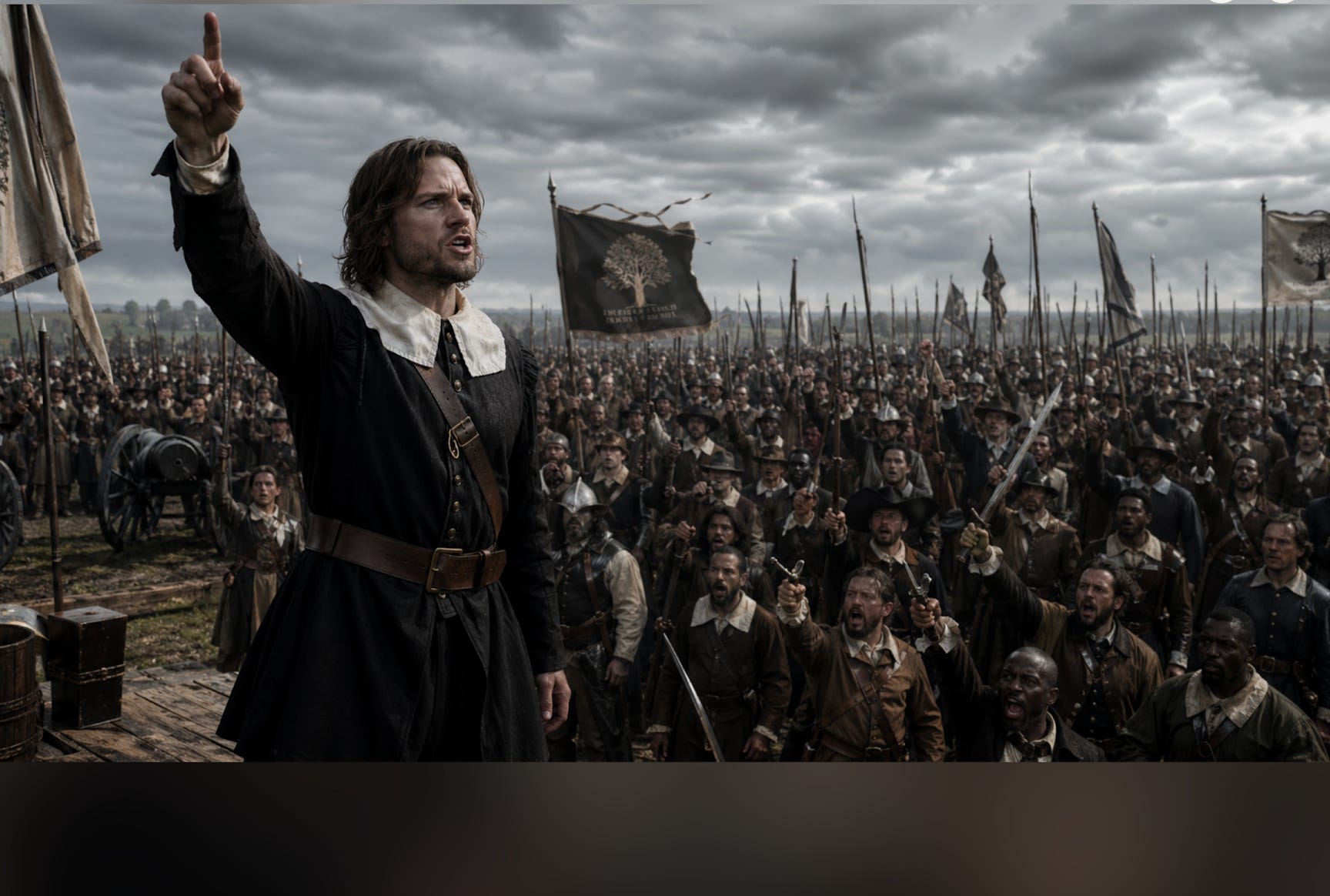
More than fifty years back the political philosopher Michael Walzer published The Revolution of the Saints (Harvard University Press, 1965), a landmark study of how Calvinist theology gave rise to the first recognizably modern political radicals.
These were the English Puritans, who prosecuted a civil war, executed a king, and created what Walzer called “an unremitting determination to transform on the basis of an ideology the existing political and moral order.”
Calvinism’s appeal, Walzer showed, could be located precisely in its comprehensive character, its obsession with personal discipline, its transmutation of the saint into a militant freed from the constraints of the conventional order and subjected only to the demands of conscience and divine will.
That profile might just fit Cole Allen.
Allen was not a believer who took leave of his faith and turned violent. He simply retained the form of his Calvinist faith while exchanging its substance.
The objection-and-rebuttal style of his manifesto, the careful biblical exegesis of the “turn the other cheek” passage in the New Testament, the formal distinction he makes between private oppression and third-party suffering can be interpreted as marks of a strange breed of theologue rather than demagogue.
Allen’s trajectory is extreme in its endpoint, but not at all in its arc.
An ample chunk of data underscores the scale of outmigration among American youth from evangelical Christianity, and but the political valences of that trend vary considerably by denomination, sect, or tradition.
Lumping them all together, at the same time, offers a warped and misleading picture.
The Pew Religious Landscape Survey of 2023-24 found that only 46% of adults aged 18-24 identify as Christian in comparison with 80% of those 65 and older — a gap of 34 percentage points, consisting perhaps in the most dramatic intergenerational religious shift in the entirety of American history.
Only 25% of the Gen Z adults attend religious services at least monthly. The share of Americans identifying as Christian has fallen from 78% in 2007 to roughly 62% in 2024.
Among Americans who regard themselves as liberal or “progressive” the percentage has dropped from 62% to 37%.
A 2026 PRRI study found that religious affiliation overall for young women has declined so sharply that the traditional gender gap has effectively closed: 57% of young women now claim a religious identity, virtually identical to 58% of young men.
But these aggregate numbers obscure a crucial internal distinction. Different evangelical traditions are losing their young people for different reasons at different rates and with very different political consequences.
The American Worldview Inventory 2024 found that only a third of self-designated evangelicals currently possess a coherent biblical worldview. Yet the psychological anatomy of the habitué of “that “old time religion” persists.
Calvinists who depart from their faith rarely drift into any sort of vague spirituality but carry with them the hardshell architecture of their convictions into a new edifice and rebuild with equal intensity.
Baptists and Pentecostals do not necessary pursue the same line of flight, but their paths of development are similar.
The broader generational overview muddies things even further.
A Johns Hopkins survey of 4,500 respondents conducted in mid-2025 determined that young Americans express deeper dissatisfaction with how the political system functions than any older cohort . They trust parties less than ever with a deep-seated belief that the system requires radical change and appear more open to extreme measures, even on rare occasion a resort to political violence, than their elders.
Those who have made a clear break with their family faith legacies are apt to feel much the same way about the religious establishment as well.
A significant subset of Gen Z, the data suggests, are processing the concurrent loss of both institutional religious and political trust with no adequate framework to put in its place.
Tim Whitaker, founder of The New Evangelicals (TNE), offers an instructive case study in how this transit typically unfolds at a safe civic distance from anything resembling violence.
Whitaker came out of a community he describes as “John MacArthur-esque” Calvinism — rigorous, predestinarian, doctrinally uncompromising — and built a politically progressive Christian platform with 323,000 followers by applying that same tenacity to his own peculiar style of “deconstruction” of conservative evangelicalism.
Whitaker has been quite candid about the danger inherent in what he helps facilitate, which is the tendency, he warns, for people leaving the “basement” of religious fundamentalism to stride straight into the next room and manufacture an equally rigid progressive fundamentalism, one that draws tightly the same “heresy” red lines and the same contempt for those who aren’t in the same space.
But Whitaker himself has at times fanned the flames of political animosity among ex-vangelicals, even if he is fairly explicit in rejecting violence.
I myself tangled with him repeatedly when he had an account on x.com because of what I perceived as his over-the-top polemics that seemed to be tarring virtually all evangelicals as heinous “Christian nationalists”, a slippery, sleazy, and largely meaningless expression that has been weaponized by the left in recent years against religious conservatives of multiple, diverse stripes.
TNE’s Facebook current page trumpets that it is all about “exposing Christian nationalism”.
Many of his detractors wonder if he needs the kind of anger-management that he prescribes for all those “Christian nationalists” out there.
Whitaker himself has been accused of “rage-fueled” driving by a female media contractor in 2024 and a subsequent effort to intimidate a journalist who wrote about the incident.
Whitaker and TNE continue to downplay the matter while insisting the facts have been misconstrued.
All things considered, anger has useful political purposes in the purview of TNE.
“Don’t let anyone convince you your anger isn’t valid”, a post on behalf of TNE on the progressive social media app Bluesky declared recently. “Righteous anger is what changed the world”.
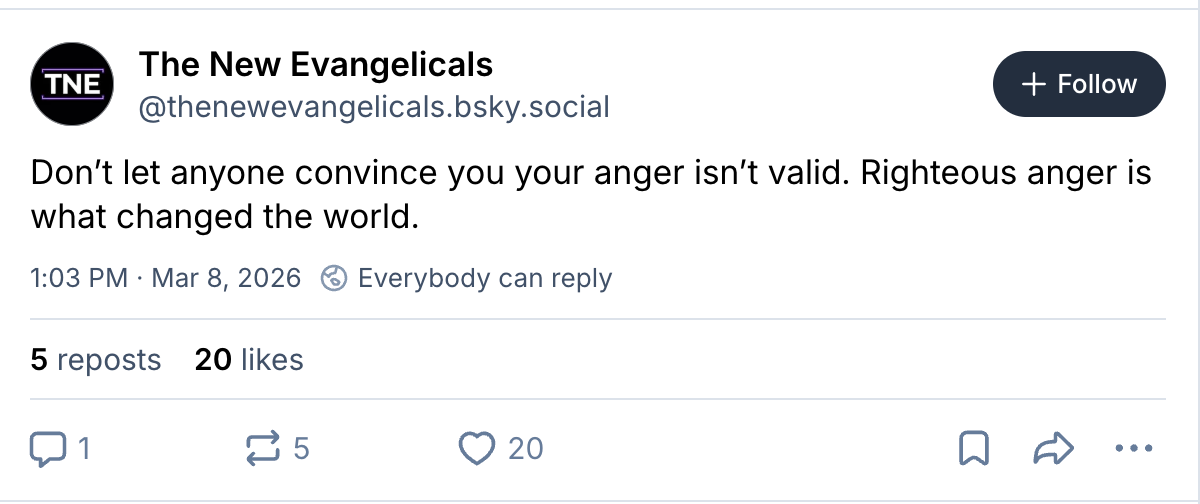
Indeed, TNE is vacuuming up all that anger to herd together young people for a high-noonish face-off with the political right in America by using rhetoric that smacks of the standardized messaging of the secular left.
Adding one more dog and pony performance to the three-ring circus of anti-Trump agitation in the streets of America, TNE is about to raise the curtain on what it terms “TNE Action”.
The TNE website states:
TNE Action is your hub for putting faith into action. Dismantling Christian Nationalism and building a more just, inclusive society requires more than TNE Action is your hub for putting faith into action. Dismantling Christian Nationalism and building a more just, inclusive society requires more than conversation - it requires collective movement. TNE Action equips, connects, and mobilizes you to stand up for your neighbors and advocate for real change.d up for your neighbors and advocate for real change.
The secular clerisy overseeing American public education from kindergarten to graduate school, especially since the start of this decade, has methodically instilled in its charges the moral mantra of “building a more just, inclusive society”.
In Allen’s mind it was necessary to do what no one had previously dared to do.
Allen’s former classmate put it with unwitting exactitude: “The idea of doing what he felt to be his duty religiously and morally, regardless of personal consequences — yes, that does seem to be in character.”
Such a bold gesture to the degree that Allen thought he had to carry it out with the aim of being true to his exacting — and perchance vengeful — God happens also to be a familiar temptation for Walzer’s revolutionary “saint” in every century in which he or she manifests.
The political channels through which we are at present decanting the tornadic force of a carefully curated militant mode of religious subjectivity were not designed to contain it.
There is neither holy sacrament nor confession box to temper it, not to mention any mitigating theology of grace to intecede for the kind of draconian logic that infected the brain of a brilliant thirty-something true believer.
Allen had no doubt he was doing something truly righteous.
He had reasoned his way to the point of reckless abandon with his own brand of scholastic surety that his background had impressed upon him at length.
In Allen we have not one more iteration of what the famous political thinker Hannah Arendt in witnessing the Eichmann trial in Jerusalem dubbed the “banality of evil”.
Let us call it the benignity of evil instead.
That is what makes Allen so utterly terrifying, yet so timely.
And that is what should make everyone of us draw a deep breath and humbly pause whenever we seek to take one adamantine position with almost berserker affect against the perceived “enemy” in the midst of our truculent, hyperpolarized politics, or when we seduce ourselves to think that nothing less than a grandiose deed of sacral violence itself is categorically imperative regardless of the fallout.
How many Cole Allens are out there right now fermenting in the seasoned oaken barrels of “new wine” that suffice for our educational, cultural, and religious institutions, even as the casks themselves are cracking at the seams?
Hard to tell — regrettably.