

New Year’s Day sometimes yields events that alter the course of human history.
The most famous one occured on January 1, 1959.
While Americans remained glued to their television sets watching the annual parades and bowl games, a relatively obscure and ragtag troop of Cuban guerillas, who had been battling the corrupt, mafia-allied Somoza regime in the Sierra Maestra mountains for years, unexpectedly burst into the capitol Havana and transformed the Cold War into a scorchingly hot one that rapidly escalated to a near-miss nuclear apocalypse three years afterwards in October 1962.
The latter is remembered to this day as the “Cuban Missile Crisis”.
New Year’s 2026 may very well turn out to be similar, although we won’t know right away to be sure.
Ironically, two significant but seemingly disparate, if not contradictory, developments could be cited on this occasion.
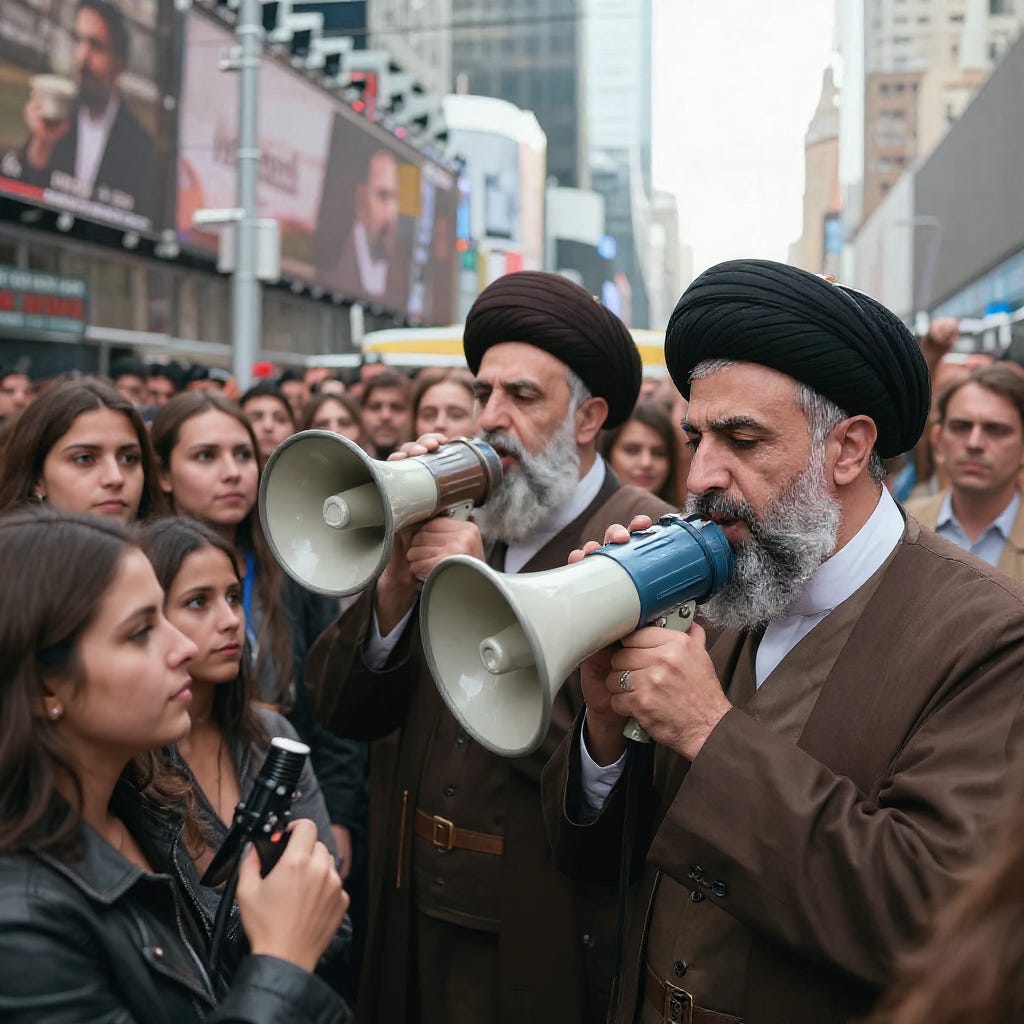
The first was the inauguration of Zohran Mamdani, the new Democratic Socialist mayor of New York City. The second was the acceleration of economic protests against the theocratic leaders of Iran into a full-blown revolutionary tremor which as of this writing seriously threaten to topple for the first time in almost half a century the Islamic Republic itself.
On the surface what happened Jan. 1 of this year appears significant, but not necessarily consequential. But we should also remember that Fidel Castro’s triumph 67 years ago could have been characterized at the time in precisely the same manner.
Few of us have the patience, the discernment, the curiosity, or the historical imagination to descry the complex underlying as well as interlocking factors that ultimately shape the so-called “defining moments” of our age.
But let’s take perhaps a more nuanced look at what is happening as we speak.
The latest crisis in Iran has the real potential to explode into a planetary firestorm in the same way that lighting sparklers during an overly exuberant New Year’s celebration at a bar in the Swiss ski village of Crans-Montana set off a tragic blaze that killed dozens and injured hundreds.
The exigency was amplified the morning after New Year’s when President Trump threatened Iran over the protest crackdown, and a senior Iranian official immediately retorted that U.S. military personnel were “legitimate targets”.
The situation is further aggravated by a very recent report from the investigative journalism site Jewish Onliner that President Trump’s incremental military confrontation with Venezuelan dictator Nicolás Maduro may have more to do with Iranian penetration into the Western hemisphere than either the public or most experts recognize.
While the Islamic Revolution of 1978-79 is now a spent force, and Iran’s projection of military force throughout the Middle East has been shattered by both Israeli and American bombers over the past year, the regime’s ideological infiltration of Western institutions and its indirect, albeit appreciable influence on civil society and its intellectual elites is highly consequential.
Iran’s “soft”, yet malign, power has spread its tentacles into many surprising corners.
One major region of impact, harking back several decades, is a bevy of state-linked charities and front organizations that promote the official Iranian agenda within this country and possibly even launder moneys from overseas.
For example, the independent news service Iran Focus in a 2010 exposé showed how the New York-based Alavi Foundation, accused by the federal government repeatedly as a being a front for the Iranian government, has donated millions of dollars to numerous colleges and universities around the country.
The Alavi Foundation’s own website itself confirms this fact.
According to Iran Focus, its investigation discovered that “the activities of the foundation were in fact directed by Iran’s then-ambassador to the United Nations, Javad Zarif.”
Zarif himself is American-educated, and his children were reportedly born in the United States. A CNN news article notes that Zarif received his bachelor’s degree from San Francisco State University and his master’s and doctorate from the University of Denver.
For several decades now Zarif in various high-level Iranian positions has functioned as the putatively friendly face of the Iranian mullahs’ extensive American influence campaign.
But even more significant than Alavi’s fraught philanthropy has been Zarif’s “Iran Expert Initiative” (IEI), which was brought to light in 2023 by the global news website Semafor.
A massive trove of leaked emails obtained by Semafor detailed how Iranian diplomats recruited and leverage European as well as American academics for political support and coordination on public messaging. The initiative sought to ensure these academics’ research, media work, and policy advice would align more closely with the Islamic Republic’s preferred narratives.
As two opinion writers from The Hill put it decisively in May of 2024:
Imagine if Russia attempted to infiltrate the U.S. government and prestigious American universities. Imagine that, by developing relationships in such high places, Russian agents facilitated the hostage-taking of U.S. students by the Russian FSB security service. Were that to happen, there would rightly be an outcry, of course. Unfortunately, this is exactly what is happening and has happened with Iran. Yet somehow, no one is talking about it, despite the obvious threat to U.S. national security.
Given the events of last June along with the real ongoing danger of Iran-sponsored terrorist “sleeper cells” bruited by federal agencies in recent months, people are now indeed talking about it - finally.
According to the Tactics Institute for Security and Counter Terrorism, the menace continues to grow and is on the radar of most sectors of the federal government.
An analysis dated September 12, 2025 states:
US homeland security strategy is undergoing renewed scrutiny amid escalating tensions with Iran, particularly in 2025. Intelligence assessments warn of sleeper cells covert operatives or sympathizers embedded within the United States as growing vectors of risk. The Iranian government, facing pressure from sanctions and regional isolation, is accused of expanding its asymmetric playbook to include low-visibility threats across US soil.
Following targeted US strikes on Iranian nuclear facilities and militias in 2024, Iran’s retaliatory posture has sharpened. Department of Homeland Security (DHS) bulletins now regularly refer to an “elevated threat environment,” flagging sleeper cells as a credible component of Tehran’s overseas retaliation strategy. The 2025 Homeland Threat Assessment names Iran as the primary state sponsor of terrorism and outlines its deliberate cultivation of foreign networks including potential assets within US borders.
What is even more troubling, as pointed out in an investigative news piece from the New York Times this past July, is that the threat increasingly may not come from direct Iranian covert actions but locally contracted thugs. Previously Iran has been known to “hire criminals — including Russian mobsters, Mexican cartel hit men and a Canadian Hells Angel — to carry out violent acts in the United States”.
A 2024 George Washington University study has catalogued Iranian activities in America under three different rubrics - propaganda, procurement, and lethal operations. It argues that religious centers, media outlets, and regime‑aligned NGOs disseminate Tehran’s worldview, glorify its allies, and undercut U.S. policy while simultaneously aiding procurement and selection of targets.
These broader, subtle, opaque yet ubiquitous activities have most likely played a major role in infecting the once secular American left with the kind of rabid antisemitism and pro-Palestinian obsession that has overtaken so much of radical American academia and the activist underground in just a few years.
There is also strong, but circumstantial evidence of an Iranian nexus in the plot just by a strange anti-Israel and faux indigenous terrorist group known as the Turtle Island Liberation Front to set off bombs across Southern California on New Year’s Eve.
Through an informant the FBI foiled the plot, but if successful the operation could have caused massive casualties.
The nexus overall can be inferred from the way in which Iranian agents of influence have co-opted – something they have been well-known to do for years - the disparate agendas of a long-fragmented American political left and mobilized them around the one overriding foreign policy objective of the Iranian Republic since its very inception.
That, of course, is the destruction and annihilation of the state of Israel and in the long run the United States itself as we know it.
The strange alchemy behind this unprecedented political process, which of course has its genesis among American academics, is outlined in an essay of mine published on this site last autumn.
As the year 2026 unfolds, we should all remind ourselves that yawning and looking the other way is never an option.
As Martin Luther King, Jr. famously said, “he who passively accepts evil is as much involved in it as he who helps to perpetrate it”.